
BLUE ECONOMY: WAYS FORWARD FOR SUSTAINABLE DEVELOPMENT OF IONS MEMBER STATES
Cooperation on MARSEC: Strengthening Maritime Security for prosperous and sustainable Blue Economy
Submitted By — Aqua Man
— The Author
Preface
The terms Blue Economy and Maritime Security have been at the forefront of almost all international forums in recent years. The two are inseparable and intertwined. While one is a facilitator, the other is a catalyst. Despite their worldwide presence, these two are defined ambiguously across platforms and scenarios. This Essay begins by settling this ambiguity. The first Chapter introduces the reader to the evolution of Blue Economy, the importance of the word ‘Sustainable’ and showcases the importance of Blue Economy for the IONS member states. The essay then proposes a Definition and Preamble of Blue Economy outlined by the 10 ‘H’s which may be adopted by the IONS. It also breaks down Maritime Security into three instruments ‘Maritime Power’, ‘Maritime Safety’ and ‘Maritime Economy’. The Essay then establishes the correlation between Blue Economy and Maritime Security coming to an understanding how the two are interdependent and how each one can benefit the other. Once the link has been established, we answer the question ‘How to make them work towards development?’ in the second Chapter. In the process, with a special focus on the Indian Ocean Region (IOR) we introduce and understand the ‘Three Elements of Prosperity’ as ‘Harnessing Oceanic Resources’, ‘Trade and Tourism’ and ‘Ocean Preservation and Maintenance’. It then highlights the Six major Challenges to Maritime Security and in turn to Blue Economy as ‘Coastal Welfare’, ‘Fisheries Management’, ‘Illegal Trade’, ‘Maritime Migration’, ‘Regional Cooperation’ and ‘Piracy’. The final chapter, shows an economic Mirror to the IONS nations and brings to light the naval power of IONS member nations. As a Way ahead towards development of a prosperous Blue Economy with the backdrop of a strong Maritime Security framework, the Essay proposes IONS to adopt the ‘3Ps of Potency’ and the ‘3Ls of Longevity’ for mutual development and cooperation amongst the IONS nations. The Essay culminates with a proposed Roadmap for the IONS comprising Short and Long Term initiatives which can be implemented for a sustainable future of the region belonging to one of the most diverse, geographically unique and rich oceans of the World, ‘The Indian Ocean’.
Chapter 1 — BLUE ECONOMY AND MARITIME SECURITY – AN INTIMATE RELATIONSHIP
What is Blue Economy?
The Genesis. The oceans have existed forever, and mankind has exploited them at will, either for the natural gifts they possess, for the life they sustain or merely as a means of transit between two land masses. Towards the end of the 20th Century when the world had recovered from the aftermath of World Wars and decolonisation instilled freedom, the human mind started looking at the earth differently. The fear of environmental changes and depleting resources came to the fore. It was at this juncture that the ‘World Commission on Environment and Development’ (WCED) was set up in 1984, under the purview of the United Nations. The commission operated for three years and published its results in the form of the Brundtland report . Apart from other environmental issues, the report also describes the Oceans as the ‘Balance of Life’ and highlights the threats to the equilibrium they maintain on earth. It calls the ‘high seas’ outside the Exclusive Economic Zones (EEZs) of individual countries as Commons and emphasises the need for better management towards sustainable development in future. The Brundtland report briefly touched upon individual aspects which years later, would resonate together to coin the term ‘Blue Economy’.
The Evolution. It was at the United Nations forum in 1994, when an Economist named Gunter Pauli, introduced the term ‘Blue Economy’ to the world. Sixteen years later, he articulated it in his book “The Blue Economy: 10 Years, 100 Innovations, 100 Million Jobs”. The prospect sounded alluring to the world and was discussed in detail during the United Nations Conference at Rio in 2012 . Three years later, the foundation of the term ‘Blue Economy’ was laid when the UN adopted the ’17 Sustainable Development Goals (SDGs) of 2030’ during the summit in Sep 20154 with ‘Life below Water’ as Goal 14. Since then, the concept of ‘Blue Economy’ has been discussed across the length and breadth of the Globe, however, the advancement towards Goal 14 has been underwhelming. Figure 1 represents progress of individual elements of Goal 14 since inception. 6 out of 10 sub goals are either stagnated or regressed while 01 requires acceleration. 3 sub goals considered on track suffer from individual challenges like Illegal Unreported and Unregulated (IUU) fishing and obscurities in UNCLOS for countries with overlapping Exclusive Economic Zones (EEZs) and Continental Shelves.

Blue Economy – The Key for IONS. The United Nations Convention on the Law of the Sea (UNCLOS, 1982) , came into force in 1994 and transformed the sovereign boundaries of littoral nations. With an additional 200 Miles of Exclusive Economic Zone under the national jurisdiction, many coastal countries, especially small island states had more territory under water than on land. A study of area under Ocean as a percentage of total self-governing area for individual member countries of IONS was undertaken for this essay by comparing the world data . It has been observed that in 14 of 25 members, the ocean covers 50 to 100 % of the total sovereign area, for six members the area under ocean ranges from 25 to 50 % and for the balance five it is below 25%. Figure 2 illustrates this study. Maldives, Seychelles and Mauritius have almost 100% ocean than land, while France and UK make up close to 87%. Singapore scores close to 50 %.

The infographic above clearly highlights that most of the littoral states have more area under the oceans than on land. Development of a sustainable Blue Economy in the Indian Ocean Region (IOR) is therefore the key for a prosperous future of the IONS nations. As a stepping stone in this direction, the essay introduces the concept of 10 ‘H’s.
Blue Economy Preamble for IONS – The 10 ‘H’s Approach
The World Bank defines Blue Economy as "sustainable use of ocean resources for economic growth, improved livelihoods, and jobs while preserving the health of ocean ecosystem." The United Nations, European Commission, Commonwealth Nations and The Centre for Blue Economy all define it differently8 . In whichever way we interpret the benefits of harnessing the oceans, the one important word that must be stitched between the terms ‘Blue Economy’ and ‘Development’, is ‘Sustainable’. Considering this as the base, the essay proposes a preamble of Blue Economy for IONS with the help of the 10 ‘H’s as articulated below:
'The art of 'Harnessing', 'Harvesting', 'Hiking', 'Healing' and 'Homogenising' the oceans for sustainable benefit of humanity without any 'Hoard', 'Havoc', 'Heist', 'Hoax' or 'Harm'.'
- Harnessing the non-living resources of the Ocean without Hoarding.
- Demarcating boundaries and Harvesting the living resources of the Ocean without any Heist.
- Hiking the high seas by bridging gaps across continents, promoting Trade and Tourism without creating any Havoc of accidents.
- Healing the Oceans by reducing pollution and curbing the Harm caused by Human discharge.
- Harmonising the Oceans through Mutual Cooperation through joint response to disasters and keeping a check on Piracy and Terrorism without any Hoax by big players for selfish motives.
The first set of five ‘H’s are the ‘Desirable Hs’ which will be further elaborated as the ‘Elements of Prosperity’ in the next chapter. The latter five are the ‘Avoidable Hs’ which constitute the challenges to Maritime security and must be countered for a sustainable Blue Economy.
The Instruments of 'Maritime Security'
An Undefined Territory. Much like the term ‘Blue Economy’, ‘Maritime Security’ is a concept for which the world has consciously not arrived at a common definition since its inception. Christian Bueger, in his 2015 paper ‘What is Maritime Security’ calls such terms as ‘buzzwords’. No concrete definition allows international acceptance of the concept while preserving local interests. Situational meanings may be interpreted either for mutual benefits or individual claims. The Essay defines Maritime Security with the help of three instruments as depicted in Figure 3. These instruments have overlapping boundaries and would be discussed in detail as part of challenges to Maritime Security discussed ahead in the essay.

*Original Infographic
Blue Economy and Maritime Security – An Intimate Relationship. For some years now, the terms ‘Maritime Security’ and ‘Blue Economy’ have been taken in the same breath. A strong Maritime Security framework provides Safety of Resources, Personnel, Trade, Regulated fishing, and early Response to Distress, both in International and Costal waters. It enables gathering of oceanographic data to predict Climate change, Sea Pollution and Early Warning. On the other hand, a flourishing Blue Economy is a guarantee for investment in the sector of Maritime Security, thereby, creating jobs and opportunities in coastal areas for Small Island Developing States (SIDS) and Low Developed Countries (LDCs). This in itself can curb some of the root causes of dangers in the Maritime domain. Finally, both fields help each other to achieve the common goal of Ocean preservation and Climate control. While Maritime security acts as a ‘Facilitator’ for the same, a sustainable Blue Economy helps provide the requisite ‘Infrastructure’. This symbolic relationship is enshrined in Figure 4. The Maritime Silk Road initiative of China10 is an example of this interdependence. While the project is aimed to provide a boost to the economy, it has warranted forward presence of Chinese navy in the IOR and fuelled China’s ship building industry creating jobs and livelihood for many.

Chapter 2 — Elements of Prosperity and Challenges to MARSEC through an IOR Lens
The Elements of Prosperity
Development of a sustainable Blue Economy on a strong foundation of ardent Maritime Security framework possesses three major elements, which this paper introduces as the three ‘Elements of Prosperity’ (Figure 5). Let us understand these elements with a special focus on the IOR.
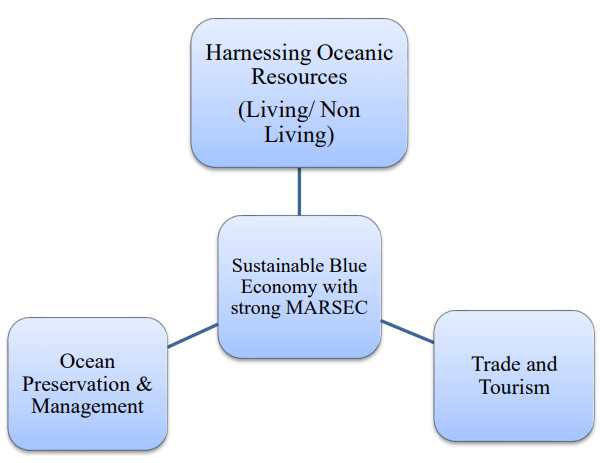
(a) Harnessing Oceanic Resources. Following the United Nations conference on the ‘Law of the Sea’ at Geneva in 1958 and 1960, a milestone achievement towards fair jurisdiction of maritime territories was the drafting of ‘United Nations Convention on the Law of the Sea (UNCLOS), in 1982. The UNCLOS is presently ratified by 168 countries and the European Union11. The Convention provides a 12 Nautical Mile (NM) limit to the Territorial Waters of a country and an Exclusive Economic Zone (EEZ) extending 200 NM. Interestingly, the idea of EEZ was conceived by an IOR country, Kenya prior drafting of UNCLOS12. The EEZ of a state does not restrict the right to transit (by sea or air), laying of pipelines and cables to others. However, it provides exclusive rights to any nation for harnessing living or non-living resources within its EEZ. The concept seems like an apt solution for conflict resolution. But what about the coastal states, most of them in the IOR, having overlapping boundaries of EEZs and Continental shelves? The UNCLOS touches upon this issue through Articles 72 and 83 towards delimitation of EEZ and Continental Shelves13 respectively. However, it does not provide a clear solution and leaves it to the peril of ‘spirit of understanding and cooperation’ between states with overlapping coasts. From closely spaced littoral states to scattered islands, the geography of the Indian Ocean serves as a perfect recipe for conflicting maritime boundaries and disputed maritime claims. The Somalia and Kenya issue with regard to delimitation of maritime boundaries, pending in the International Court of Justice since 2014 is just an example amongst many14 . Consequently, non-living resources like Oil, Natural gas, Minerals and alternate sources of energy lie unutilised as International companies are extremely sceptical of investing in disputed territories. On the other hand, absence of demarcated boundaries poses difficulties in harnessing living resources from aquaculture, fisheries and bio technology. They also bring along the challenge of Illegal Unregulated and Unreported fishing, hampering economies of small island states.
(b) Trade and Tourism. Marine trade accounts for about 80% of the global trade15 and is one of the most crucial aspect not only of a sustainable Blue Economy, but the stability of world economy as well. The Indian Ocean plays a vital role in maritime trade connecting the Middle East, Asia and Africa to Europe. Around 100,000 ships transit the Indian Ocean annually, carrying over one third (34%) of the world’s total cargo volume and two thirds (66%) of the world’s sea borne oil shipments16 . Major chokepoints include ‘The Strait of Hormuz’ connecting the Gulf of Oman to the Persian Gulf, ‘The Bab El Mandeb’ connecting the Red Sea to the Gulf of Aden towards the Indian Ocean and ‘The Strait of Malacca’ connecting to the South China Sea. Besides this, Marine Tourism is the backbone of the economies of coastal countries, especially the SIDS and LDCs. For example, tourism contributes 22.5% towards the GDP of Maldives, the highest by any single sector17 . Marine Trade and Tourism hence form a vital element of prosperity towards a sustainable Blue Economy. However, recent Maritime security issues plagued by Piracy and Terrorism have seriously hampered the shipping sector in the IOR. The ‘Strait of Hormuz’ and ‘The Bab El Mandeb’ remain the two chokepoints (Figure 6) in the Western IOR prone to Piracy and Armed robbery.

Recent Pirate attacks off the Somalian coast and the Houthi rebels of Yemen19 have disrupted normal sea farers and shipping in the region. Consequent to dangers of Houthi attacks and armed robbery in the region, major shipping giants Mediterranean Sea Company (MSC), Maersk, CMA CGM and Hapag Lloyd suspended their shipments through the Red Sea and in turn chose a safer but longer route through the Cape of Good Hope. Together these companies account for about 54.20% of the world’s Global Merchant Fleet (Figure 7)

The rerouting of such substantial share of merchant vessels accounts for increase in voyage distance thereby hiking per container transportation costs. This implies rise in global import export rates, inflation and further disruption of world order especially in the IOR.
(c) Ocean Preservation and Management. For over two decades now, the importance of preserving oceans for the benefit of humankind has been the talk of the World. Issues of ocean acidification, plastic pollution, rising sea levels and eutrophication have been discussed globally. Enforcement regulations are just a part of the bigger picture. The role of Maritime security in sustainable development and management of Blue economy lies ahead. Constant gathering of oceanographic and hydrographic data, research in Marine environment, minimising accidents to prevent oil and other chemical spillage, development of strong Maritime Domain Awareness (MDA) picture so as to foresee and efficiently counter natural disasters are aspects which need to be addressed for preservation and better management of the Oceans. The situation narrows down in the IOR which consists largely of developing or low developed countries. Corruption, reluctance to adhere to laws, overlapping boundaries, illegal migration and unaccountability due to a robust legal framework have led to a degration of Ocean Health Index score of the region (as depicted in Figure 8) and hindered progress towards SDG 14 and a sustainable Blue economy.
The situation narrows down in the IOR which consists largely of developing or low developed countries. Corruption, reluctance to adhere to laws, overlapping boundaries, illegal migration and unaccountability due to a robust legal framework have led to a degradation of Ocean Health Index score of the region (as depicted in Figure 8) and hindered progress towards SDG 14 and a sustainable Blue economy.

The Indian Ocean is the warmest in the world23 and is affected by strong winds and violent monsoons. Frequent floods and natural disasters like Tsunami have haunted its littoral states throughout history. Major part of natural resources of the region are still unexplored. The continental shelves alone, which comprise about 4.2% of the total ocean are found to be rich in minerals like Cobalt, Uranium, Nickel, Gold and Cadmium24 . This calls for consistent efforts in reducing corruption, educating masses and regional cooperation. While organisations like the Indian Ocean Naval Symposium (IONS) are constantly working towards these goals, efforts of individual nations like India’s Maritime Anti-Corruption network25 which aims to reduce integrity issues and increase efficiency through education and training need reinforcement.
Challenges to Maritime Security
The instruments of Maritime security discussed in the first Chapter face multiple challenges. In the IOR, these challenges can be broadly classified into six major categories as depicted in Figure 9.
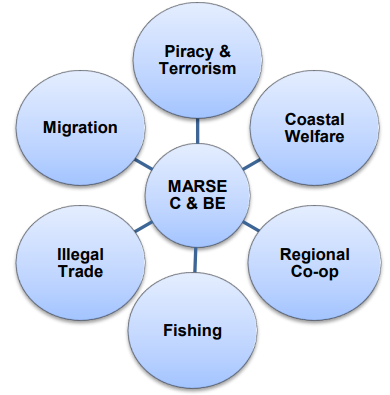
(a) Coastal Welfare. The economic and social welfare of coastal states and adjacent areas is directly proportional to the state of Maritime safety and security in the region. Empty stomachs and disaffected minds are perfect ingredients for violence and robberies. Once the masses are convinced that such is the state of affairs and relief can come only through illicit and unlawful means, then perspectives change the unfair to fair and illegal to legal. This goes into a vicious circle and before the world realises, roots grow so deep that the traditions prevail for posterity. Somalia is a classic example. Plagued with hunger, poverty and groups like al-Shabaab, it is one of the leading places affected by piracy, trafficking, and smuggling. Somalia has the lowest Coastal Welfare score out of all the 71 countries in the region of study by the NGO Stable Seas . Towards the East IOR, there are nations like Australia and Singapore that have good costal welfare scores, but there are also countries like Myanmar and Timor-Leste which require immediate attention. Improvement in maritime security with fair governance, development of marine industries, fisheries and tourism would help in providing the basic infrastructure towards jobs and opportunities for the local population.
(b) Fisheries Management. Amongst all the living resources that are harvested from the ocean, fisheries are the most important. They contribute towards both the export and food intake of many developing and under developed coastal countries especially in the IOR. The development and sustenance of fisheries around a country depends upon the initiative of Marine Protected Areas (MPAs). These are areas which limit human and industrial activities in the region so as to safeguard marine life. As per data from Stable Seas, out of 71 countries of the world, only 21 have marked MPAs. In the IOR, except a few countries like Seychelles, Australia, Indonesia, UAE, the United Kingdom and India, the efforts in establishing and maintaining firm MPAs have been underwhelming. The Western IOR accounts for about 20% of Tuna and the waters are home for other important species like the swordfish, sailfish and marlin. Whereas, the Eastern Indian Ocean Region is a hub of some of the world’s highest fish producing and exporting nations with some of the largest coral reefs. However, the fishing resources of the region are constantly under threat due to pollution, overfishing and Illegal Unregulated and Unreported (IUU) fishing. The high fish to food ratio of littoral states and development of large, profit centric industries in the fishing sector make fisheries one of the most critical factors in the maritime domain. If left unregulated, hoard over depleting resources can lead to violent conflicts, slavery for cheap labour, human trafficking and smuggling. Countries like Indonesia and Seychelles, which lay special impetus in maintaining their fisheries and MPAs are an example for others to follow.
(c) Illegal Trade. Illicit trade through the oceans poses a potent challenge to the development of world economy. While the land and air routes have been supplemented with multiple checkpoints and regulations, trafficking through the maritime domain remains the easiest, as containers are seldom inspected at ports. Illegal items like wildlife products, drugs, arms and other restricted goods are transported from the source country to the country in transit prior entering the country of delivery. This forms a complete network hampering the formal mechanisms of import and export. The littoral states in Asia and Africa have traditionally been the transit points for products to be delivered in Europe and North America. However, with recent advancements and expansion of tourism, some of them are developing into target markets themselves.
(d) Maritime Migration. Maritime migration includes human trafficking for slavery or sex and illegal transit aiding wilful migration for economic or religious purposes. The industry either thrives on masquerading containers in huge merchant vessels or use of unsafe boats and untrained crew. In both cases, insurance does not exist and assurance of reaching the destination is very bleak. In the West, illegal migrants from Somalia and Mozambique traverse the shorter sea route for alluring opportunities in the Middle East. While in the East, owing to diverse economic and religious patterns of nearby coastal regions, migration gains its value. Examples include the inflow of Cambodian migrants into Thailand and large migration into Indonesia. Maritime migration can be treacherous to the economic state of nations and can be detrimental in curbing sustainable development. The Rohingya migration of 2015, wherein 2500 refugees from Myanmar, traversed the sea to reach Indonesia, Malaysia and Thailand is one prominent example. Around 8000 of these migrants were stranded at sea and the ones who made it were in shock and malnourished.
(e) Regional Cooperation. Traditionally, cooperation amongst states in the IOR has been praiseworthy. While most IOR nations are part of one or the other maritime cooperation groups, Australia, Sri Lanka, Mozambique and Seychelles stand out, as they scored a 100% in the international cooperation scores compiled by the Stable Seas . Various efforts like the ‘Indian Ocean Naval Symposium’ with 25 members, the ‘Indian Ocean Rim Association’ with 23 members and ‘Goa Maritime Conclave’ with 14 members have helped nurture regional cooperation in the IOR and provide forums for discussing important aspects related to maritime security and way ahead towards a sustainable Blue Economy. Another important aspect is the growth of information sharing networks. The ‘Information Fusion Centres (IFCs)’ in Seychelles and India and the International Maritime Bureau of Piracy Reporting Centre are frameworks that stand testimony to the regional cooperation in the Indian Ocean Region.
(f) Piracy. The whole act of Johnny Depp and his ‘Pirates of the Caribbean’ would have lured much applause, however, when it comes to real life pirates, the situation is not as lucid as on celluloid. In the maritime domain piracy is a nuisance that has inflicted not only financial but also physical and mental harassment to personnel who have fallen victim to it. On multiple instances, the crew has been kept hostage for weeks and tortured to extreme extents. Concerted efforts by navies across the world has helped curb piracy to an extent. However, in recent years, the devil has resurfaced. On 14 December 2023, the Somalian coast experienced the first act of hijacking since 2017, wherein, a Malta flagged bulk carrier MV Ruen was boarded and taken over. The vessel was finally rescued by the heroics of Indian Navy’s ‘Operation Sankalp’. Following the Israel – Hamas conflict and the Houthi stand, there stands a major risk to vessels transiting through Bab El Manded towards Yemen and the Red Sea. Vessels are called through loud
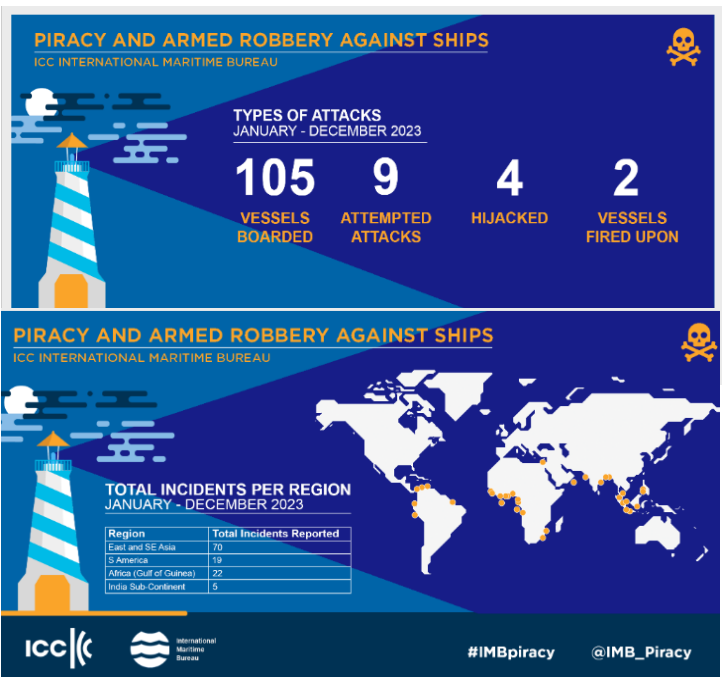
hailers or VHF and are asked to divert course to Yemeni waters. Towards the Eastern IOR, areas of concern include ‘The Malacca Strait’ (extending to the Singapore Strait), Indonesia and Malaysia. These incidents are mostly classified as ‘Armed Robberies’ on vessels primarily on Anchorages. Consistent efforts can help reduce such incidents. For example, constant dialogue between the Indonesian Marine Police and the International Maritime Bureau – Piracy Reporting Centre (IMB – PRC) has brought positive results . In 2023, worldwide figures account for 120 Piracy and Armed robbery incidents, as depicted in Figure 10, most of them concentrated in East and South East Asia
Chapter 3 — Marching Hand in Hand Towards Prosperity: Way Ahead for 'IONS'
— Charter of Business, IONS
The Mirror for IONS
The Indian Ocean Naval Symposium comprises 25 Members, out of these nine countries are in the list of Small Island Developed States and Low Developed Countries35 . 16 score less than 50% on the Financial Freedom Index and 13 score less than 60% on the Overall Index of Economic Freedom36 .The state of economic development for states of the Indian Ocean Region as compared to the world can be assessed through the ‘World by Income’ map of the World Bank
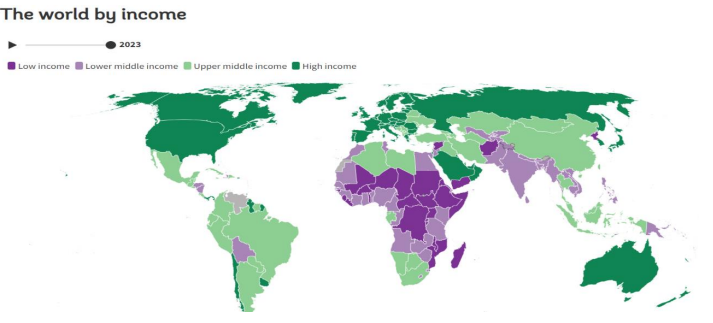
It is evident from Figure 11 that as compared to the world, the countries of the IOR have sufficient room for economic development. Most of these countries are littoral states and development of a sustainable blue economy can lead to significant growth through generation of jobs, trade, tourism and investment in maritime security sector.
Maritime Security Capacity and Capability
The IOR is a blend of capacity of Maritime forces. While India and China make their presence felt with strong and growing fleets along with the Australian, French, British and USA prominent presence, other players like the Maldives, Mauritius and Seychelles do not possess the manpower or materiel strength, solicit support from others. The Global Firepower (GFP) ratings of 2024 , the rating of Navies of IONS members is depicted in Table 1.
| Ser | Country | Global Rank of Naval Fleet |
|---|---|---|
| (a) | Indonesia | 06 |
| (b) | India | 08 |
| (c) | Thailand | 09 |
| (d) | Sri Lanka | 10 |
| (e) | Myanmar | 13 |
| (f) | France | 26 |
| (g) | Qatar | 28 |
| (h) | Bangladesh | 30 |
| (j) | United Kingdom | 31 |
| (k) | Pakistan | 32 |
| (l) | Iran | 37 |
| (m) | Malaysia | 38 |
| (n) | UAE | 42 |
| (p) | Saudi Arabia | 53 |
| (q) | South Africa | 55 |
| (r) | Australia | 61 |
| (s) | Singapore | 62 |
| (t) | Oman | 81 |
| (u) | Kenya | 85 |
| (v) | Tanzania | 93 |
| (w) | Mozambique | 103 |
| (x) | Mauritius | National Coast Guard |
| (y) | Maldives | Coast Guard |
| (z) | Seychelles | Coast Guard |
Source: Global Firepower, Navy Fleet Strength by Country (2024)
The 3 Ps of Potency
The strength of any institution is attributable to its Potency which helps it withstand hard times. The Essay proposes for the states of IONS to adapt and strengthen ‘The 3 Ps of Potency’ as depicted in figure 12. These Ps of Potency can be defined as follows: -
(a) Power.Building a strong presence in the Indian Ocean Region through a ‘Combined Maritime Force’ with representation from Navies of all the Member and Observer states. For the primary framework, lessons may be taken from the model and success of the ‘Combined Task Force’ which was initiated by the USA, UK and Australia forming a coalition to protect freedom of navigation and trade through the ‘Strait of Bab el Mandeb’ and the ‘Strain of Hormuz’ . For nations with smaller navies or police forces, this may be an opportunity to learn and get trained about how the bigger navies operate. Presence of a Combined Maritime Force with ships, submarines and boats of various capacities and capabilities would help in protection of not only national boundaries but also provide safety to the ‘Elements of Prosperity’ in the high Seas. The ‘Indian Ocean Combined Maritime Force’ (IOCMF) promises to be a stepping stone to higher cooperation in the IOR, leading towards a common goal of prosperity through cooperation in Maritime Security. The Naval strength of IONS nations as brought out in Table 1 promises the capability and capacity of the Navies of member states to contribute to the IOCMF. The allocation of assets can be on a rotational basis with cross exchange of crew members as Sea Riders for joint capability development.
(b) Policies. Swift and sensible decision making is a function of deeply pondered and well stitched policies. The policies formulated should not be generalised and each Challenge towards Prosperity as discussed in Chapter 2, must be addressed with an individual set of plans and rules. As the saying goes that ‘A chain is as strong as its Weakest link’, each policy much be designed catering the strength and weak areas of individual members of the IONS. An effective and well planned policy structure today is the foundation stone for a strong Maritime Security framework.
(c) Penalties. At last, the Power and Policy framework would only function under a set of rules as mutually agreed by the states of IONS in an international forum. The nations should resolve, first, not to break the code of conduct, however, in case of any deviation by anyone, the parallels must be drawn right and penalties as deemed suitable must be imposed so as to protect the sanctity of the institution.

The 3 Ls of Longevity
The success of an institution and effectiveness of its decision making is a direct function of mutual cooperation, understanding and flexibility amongst member states which leads to longevity of mutual trust. Considering the diverse economies, cultures and interests of the IONS states, the essay proposes the members to adapt and advance with the modern world by focussing on the ‘3 Ls of Longevity’ as depicted in Figure 13.
(a) Language. Leaders of IONS nations must agree to follow the protocol to adopt a ‘Language of Prosperity and Development rather than Contestation’. Owing to the geography of the Indian Ocean Region, overlapping disputes cannot be eliminated and will always persist. However, the way we deal with these issues will determine our path towards prosperity or hardships. The historic ‘Maritime Boundary Treaty’ between Australia and Timor-Leste is a perfect testament before the world, how rules can be upheld and mutual cooperation can lead to mutual development.
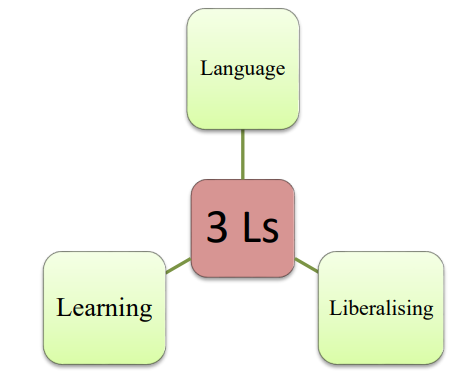
(b) Learning. The world is technologically evolving at a fast pace. To keep abreast with the swift pace, it is important to learn and grow together. The IONS has members and observers from all facets of the World. Utilising the platform for technological advancements and developing state of the art technologies in the IOR will help in development of a holistic Maritime Domain Awareness, counter Piracy and Terrorism and overcome other challenges to prosperity. Pooling in knowledge and resources for setting up sturdy Cybersecurity networks and harnessing Satellite technology would help in strengthening communication and early warning in times of distress or disasters. Further, initiatives in the field of research and constant gathering of hydrological data is crucial to predict climate changes, wind patterns and Search and Rescue operations. Being flexible towards transfer of technology and learning together for mutual benefits is the key for longevity and prosperity.
(c) Liberalisation. As discussed, many of the IONS member states fall in the category of SIDS and LDCs. Apart from tourism, the economies of these states are primarily dependent on Marine assets like fisheries and marine habitats. However, the infrastructure required to sustainably utilise the marine sector can be substantial. Mostly, the SIDS and LDCs do not have the capital to invest and harness the complete potential of marine resources they possess. This is where the mutual cooperation can be helpful. An example of the idea is the issue of ‘Blue Bonds’ by Seychelles. A country with fisheries accounting for 17% of net GDP and fish products amounting to 95% of the total export , Seychelles realised its potential and came up with the concept of ‘Blue Bonds’ to raise funds for better management and governance of the fisheries sector. Consequently, sovereign Blue Bonds worth USD 15 Million were issued which benefitted the local population through development of the sector. This is just one example of a nation being liberal in its thought process.
Roadmap for IONS – Initiatives in MARSEC Cooperation for a Sustainable and Prosperous Blue Economy
To keep abreast with the swift technological advancements and present day volatile world order, the IONS should quickly adapt and must possess a crisp road map of what the institution aims and desires to achieve. A few implementable key initiatives which the IONS can adopt are proposed below: -
(a) Short Term Initiatives.

- Start a SIP (Seminar for Investment and Prosperity). A central conference inviting companies, businessmen and venture capitalists from across the IONS member states to collaborate ideas for development and investment in the Maritime security and Blue Economy sector aimed towards achieving selfsufficiency in the IOR.
- 'ICE' for the Ocean. Setting up the 'IONS Cognoscenti Enclave' comprising scientists, researchers, scholars and learned people specialising in the Maritime sector who would work together in the field of research and development, collaborating plans and procedures towards achieving a strong maritime security structure in the IOR and development of a sustainable Blue economy.
- Setting up a 'HOOTER'. With the advent of AI and machine learning, it is important that the IONS members come together and establish a 'Hub for Ocean Technological Expansion and Research' primarily aimed towards implementation of technology in the maritime sector for the benefit of IONS nations.
- 'SIT' in IOR. As a measure to support the Small Island and Lesser developed members of the IONS, a 'Subsidised Inland Tourism' (SIT) model amongst the IONS member states is proposed. Countries can provide subsidies on travel and tourism to sister littoral nations of the IONS.
- Deputing ILOs. The information fusion centres are a hub for seamless information exchange, data gathering and research. Deputing International Liaison Officers on permanent deputation to such institutions helps in better communication and swift decision making. The IFC-IOR in India, for example, presently has ILOs from 15 countries in the IOR.
(b) Long Term Initiatives.
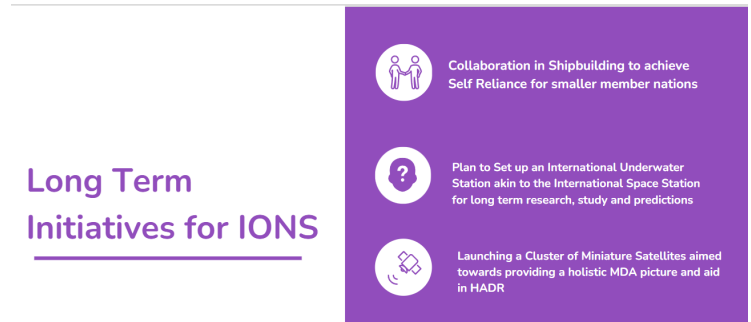
- Collaboration in Shipbuilding. Nations with stronger navies and infrastructure are already helping other small nations in the IOR by providing ships and boats. India’s contribution of Water Jet Fast Patrol Vessel and fast interceptor boats to the Mauritius National Coast Guard in 2016-17 and handing over INS Varuna (commissioned as INS Suraksha in Sri Lankan coast guard in Oct 2017) to Sri Lanka are few examples. Taking a step forward, this essay proposes that bigger nations like India, Australia, France and United Kingdom help the small littoral states self-reliance in ship building capabilities through transfer of technology and infrastructure.
- Setting up an International Underwater Station. Akin to the International Space Station, an International Underwater Station may be set up in the Indian Ocean Region. This would provide the aquanauts to reside under water for longer durations and establish holistic underwater networks.
- Cluster of Miniature Satellites. With advancements in satellite technology, the IONS can launch a miniature satellites in the Low Earth Orbit over the IOR. These would help develop a holistic Marine Domain Awareness (MDA), establish better communication and achieve retrieve real time data on Climate change and in time of disasters.
Conclusion
As the world advances towards a sustainable Blue Economy, the contribution from the littoral states of the IOR is going to be vital. Towards this, we must start working towards nourishing the ‘Elements of Prosperity’ and countering the challenges to MARSEC in the IOR. An effective model can be devised from the 3 Ps of Potency and the 3 Ls of Longevity to enhance strength and flexibility of mutual cooperation and implementation of goals. An immediate measure which the IONS can implement is the publication of an annual Blue Economy Report of the IOR, as its flag ship report akin to that of the European Union. The Indian Ocean Region with immense assets, provides equally vast opportunities for its littoral nations to adopt ways and means to harness the best resource they have at their feet ‘the Ocean’.
Bibliography
- ‘How Do Trees Give Earth All Its Oxygen?’, Science Questions with Surprising Answers, accessed 21 July 2024, https://wtamu.edu/~cbaird/sq/2013/01/05/how-do-trees-give-earth-all-itsoxygen/
- ‘Brundland Report’, accessed 21 July 2024, https://sustainabledevelopment.un.org/content/documents/5987our-common-future.pdf
- ‘United Nations Conference on Sustainable Development, Rio+20. Sustainable Development Knowledge Platform’, accessed 21 July 2024, https://sustainabledevelopment.un.org/rio20.
- ‘United Nations Sustainable Development Agenda’, United Nations Sustainable Development (blog), accessed 21 July 2024, https://www.un.org/sustainabledevelopment/development-agenda-retired/.
- ‘UN SDG Progress-Chart-2023.Pdf’, accessed 21 July 2024, https://unstats.un.org/sdgs/report/2023/progress-chart/Progress-Chart-2023.pdf.
- ‘United Nations Convention on the Law of the Sea’, accessed 21 July 2024, https://www.un.org/depts/los/convention_agreements/texts/unclos/unclos_e.pdf.
- ‘Ocean to Land Percentage’, World Economic Forum, 16 October 2017, https://www.weforum.org/agenda/2017/10/global-ocean-governance-all-at-sea/.
- ‘Blue Economy Definitions’, accessed 21 July 2024, https://www.un.org/regularprocess/sites/www.un.org.regularprocess/files/rok_part_2.
- Christian Bueger, ‘What Is Maritime Security?’, Marine Policy 53 (March 2015): 159–64, https://doi.org/10.1016/j.marpol.2014.12.005.
- Michael J. Green, ‘China’s Maritime Silk Road: Strategic and Economic Implications for the Indo-Pacific Region’, 4 February 2018, https://www.csis.org/analysis/chinas-maritime-silkroad-strategic-and-economic-implications-indo-pacific-region.
- ‘Nautical Law: What Is UNCLOS?’ accessed 24 July 2024, https://www.marineinsight.com/maritime-law/nautical-law-what-is-unclos/.
- Michelle Voyer et al., ‘Maritime Security and the Blue Economy: Intersections and Interdependencies in the Indian Ocean’, Journal of the Indian Ocean Region 14, no. 1 (2 January 2018): 28–48, https://doi.org/10.1080/19480881.2018.1418155.
- ‘Overlapping EEZ and Continental Shelves - UNCLOS Page 52 & 56’, n.d.
- ‘Maritime Delimitation in the Indian Ocean (Somalia v. Kenya)’, accessed 24 July 2024, https://www.icj-cij.org/case/161.
- ‘Review of Maritime Transport 2023’, 27 September 2023, https://unctad.org/system/files/official-document/rmt2023_en.pdf.
- United Nations Conference on Trade and Development, ‘International Maritime Trade’, 27 September 2023, https://unctad.org/system/files/official-document/rmt2023ch1_en.pdf.
- 'Maldives Tourism Yearbook 2023', accessed 24 July 2024.
- ‘Strategic Routes for Oil and Natural Gas Shipments - U.S. Energy Information Administration (EIA)’, accessed 24 July 2024, https://www.eia.gov/todayinenergy/detail.php?id=41073.
- ‘Maritime Menace: Resurgence of Somali Piracy’, orfonline.org, accessed 24 July 2024, https://www.orfonline.org/expert-speak/maritime-menace-resurgence-of-somali-piracy.
- Agencies and ToI Staff, ‘Shipping Firms MSC and CMA CGM Are Latest to Suspend Passage through Red Sea’, accessed 24 July 2024, https://www.timesofisrael.com/shipping-firmsmsc-and-cma-cgm-are-latest-to-suspend-passage-through-red-sea/.
- ‘Global Merchant Fleet Top 100’, accessed 24 July 2024, https://alphaliner.axsmarine.com/PublicTop100/.
- ‘Scores | OHI’, accessed 24 July 2024, https://oceanhealthindex.org/global-scores/.
- ‘Warmest Ocean in the World’, accessed 24 July 2024, https://www.guinnessworldrecords.com/world-records/93263-warmest-ocean.
- ‘Wanni Arachchi Kankanamge, Piyantha Warna Kumara. (2023). CREATING A STRATEGIC FRAMEWORK FOR MARITIME SECURITY COOPERATION IN THE INDIAN OCEAN REGION’, n.d
- ‘India - MACN’, accessed 24 July 2024, https://macn.dk/india/.
- ‘Coastal Welfare’, accessed 24 July 2024, https://www.stableseas.org/_files/ugd/1e2140_da096261f5fa4ee9be6d29bd25ffe563.
- ‘Fisheries’, accessed 24 July 2024, https://www.stableseas.org/_files/ugd/1e2140_530c60b1411f473fb4058f9ee5a82054.
- ‘Illicit Trade’, accessed 24 July 2024, https://www.stableseas.org/_files/ugd/1e2140_53b96057ee094ec8a368d6ff2588b638.
- ‘Maritime Mixed Migration’, accessed 24 July 2024, https://www.stableseas.org/_files/ugd/1e2140_dedeb54bccff4f79888e19a054dc2518.
- ‘International Maritime Cooperation’, accessed 24 July 2024, https://www.stableseas.org/_files/ugd/1e2140_ab7c2e2a6bf34460bc495f90011b31f7.
- ‘INDIAN NAVY’S ONGOING MARITIME SECURITY OPERATIONS (“OP SANKALP”) 14 DEC 23 TO 23 MAR 24’, accessed 24 July 2024, https://pib.gov.in/pib.gov.in/Pressreleaseshare.aspx?PRID=2016201
- Administrator, ‘PIRACY AND ARMED ROBBERY PRONE AREAS AND WARNINGS’, accessed 24 July 2024, https://www.icc-ccs.org/index.php/piracy-reportingcentre/prone-areas-and-warnings.
- 'South East Asia and Indian Sub Continent Piracy', accessed 24 July 2024, https://www.icc-ccs.org/index.php/piracy-reporting-centre/prone-areas-and-warnings.
- Josh Lamorena, ‘New IMB Report Reveals Concerning Rise in Maritime Piracy Incidents in 2023’, accessed 24 July 2024, .
- ‘UN List of Least Developed Countries | UNCTAD’, accessed 24 July 2024, https://unctad.org/topic/least-developed-countries/list.
- ‘Index of Economic Freedom: About the Index | The Heritage Foundation’, accessed 24 July 2024, https://www.heritage.org/index/pages/about.
- ‘WDI - The World by Income and Region’, accessed 24 July 2024, https://datatopics.worldbank.org/world-development-indicators/the-world-by-income-andregion.html.
- ‘Navy Fleet Fleet Strength by Country (2024)’, accessed 24 July 2024, https://www.globalfirepower.com/navy-ships.php.
- Mike Schuler, ‘Naval Coalition Celebrates One Year Protecting Shipping in Strait of Hormuz and Bab El-Mandeb Strait’, gCaptain, 10 November 2020, https://gcaptain.com/navalcoalition-celebrates-one-year-protecting-shipping-in-strait-of-hormuz-and-bab-el-mandeb-strait/.
- ‘Australia’s Maritime Arrangements with Timor-Leste | Australian Government Department of Foreign Affairs and Trade’, accessed 24 July 2024, https://www.dfat.gov.au/geo/timor-leste/australias-maritime-arrangements-with-timor-leste.
- ‘Sovereign Blue Bond Issuance: Frequently Asked Questions’, Text/HTML, World Bank, accessed 24 July 2024, https://doi.org/10/29/sovereign-blue-bond-issuance-frequently-askedquestions.
- ‘REVISITNG “SAGAR” – INDIA’S TEMPLATE FOR COOPERATION IN THE INDIAN OCEAN REGION’, National Maritime Foundation (blog), 25 April 2018, https://maritimeindia.org/revisiting-sagar-indias-template-for-cooperation-in-the-indian-oceanregion/.
- Directorate-General for Maritime Affairs and Fisheries (European Commission) et al., The EU Blue Economy Report 2024 (Publications Office of the European Union, 2024), https://data.europa.eu/doi/10.2771/186064.