
BLUE ECONOMY: WAYS FORWARD FOR SUSTAINABLE DEVELOPMENT OF IONS MEMBER STATES
Pseudonym — POLARIS
Introduction
The perspective of positivity matters. It varies from individual to individual, organization to organization, how they look through their lenses at something from which perspective: positivity or negativity. For instance, how a person explains a half glass of water. Someone may describe it as half-filled or half-empty. But someone can explain better, halffilled with water and half-filled with oxygen. This is the perspective of positivity. When the lenses of all perspectives are fixed and focused correctly with the perspective of positivity, only then we can have an optimum effect.
A similar analogy applies when the issue of the Indian Ocean Region (IOR) comes into play. IOR holds immense strategic, economic and geopolitical significance. Its potential spans, various domains, including trade, energy, security and regional cooperation. There are a number of littoral states that depend on the IOR. Again within a state, there are civil and military stakeholders. The issue of perspective again plays here. From which perspective, all these intra-state and inter-state stakeholders are glancing at IOR. When the perspectives of all the maritime stakeholders are aligned in dealing with the IOR for a common goal, then it will have the desired effect.
In the late 1980s, the eminent strategic analyst, Barry Buzan, articulated the concept of a 'Regional Security Complex' to describe "…a group of states whose primary security concerns link together sufficiently closely that their national securities cannot realistically be considered apart from one another". The Indian Ocean Naval Symposium (IONS) is a crucial platform for fostering maritime cooperation and security in the IOR. By enhancing collaborative efforts building capacity and promoting diplomatic engagement, IONS can significantly contribute to consolidating the IOR into a Maritime Regional Security Complex, ensuring collective security and stability in this strategically vital part of the world.
In 2023, Thailand succeeded France in chairing the IONS. Thailand continues and expands the focus of IONS through an exploration of the role of navies in safeguarding the Blue Economy. The concept of The Blue Economy embraces a plethora of stakeholders at the state level and across the compass of IOR whose perspectives are to be aligned in shaping the future of the Blue Economy for sustainable development. It is therefore vital to understand the gamut of the blue economy and inspire meaningful action by the IONS member states.
The workhorses of IONS are the working groups. They focus on Humanitarian and Disaster relief, Information Sharing and interoperability and crosscutting issues of Maritime Security (MARSEC). It is imperative to maximize cooperation on MARSEC to strengthen MARSEC for a prosperous and sustainable blue economy.
This paper first highlights the gamut of the Blue Economy and its challenges and opportunities for IONS member states for sustainable development. Then it discusses the link between the blue economy and maritime security. Thereafter, the discussion delves into the cooperation on MARSEC for strengthening maritime security for a prosperous and sustainable Blue Economy of IONS member states.
Aim
The aim of this paper is to analyze the scope of cooperation in MARSEC for strengthening MARSEC for a prosperous and sustainable Blue Economy of IONS member states.
The Gamut of Blue Economy
The Concept of Blue Economy
The term 'Blue Economy' has indeed gained prominence since the 2012 United Nations Conference on Sustainable Development (UNCSD), also known as the Rio+20 Conference. Emerging as the marine counterpart to the broader 'green economy,' the Blue Economy focuses on fostering sustainable development of oceanic resources while ensuring ecological health and social equity. It was defined as an economy "that results in improved human well-being and social equity, while significantly reducing environmental risks and ecological scarcities". The Blue Economy emerged to reflect the fact that over 70% of the earth's surface is water. Protecting ocean health is essential for maintaining global climate stability and ensuring the sustainability of human and ecological systems.
The components of the Blue Economy are very diverse, ranging from the fisheries and aquaculture to oil and gas mining and other sea related economic activities such as transportation and Tourism.
| Harvesting Living Resources | Extraction of Nonliving Resources | Other Economic Activities | Protection of the Sea |
|---|---|---|---|
| Fisheries | Mineral, gravel and sand | Maritime transportation | Marine surveillance |
| Aquaculture and Non-traditional species | Oil and gas | Ports and related services | Protection of marine and coastal environment |
| Marine biotechnology | Desalination (freshwater generation) | Shipbuilding and ship breaking industry | Waste management |
| Bio-prospecting | Renewable marine (offshore) energy | Coastal and maritime tourism | Blue carbon |
| Seafood processing | Sea-salt generation | Marine services | Ecological/ecosystem reserve |
Source: Moutusi Islam, Blue Economy and Bangladesh: A Balanced Approach Between Development and Conservation in Anasua Basu Ray Chaudhury and Harsh V. Pant, eds, Anchoring the Bay of Bengal in a Free and Open Indo-Pacific, (New Delhi: ORF and Global Policy Journal, 2024).
The components of the Blue Economy have been categorized into four major groups based on the nature of the activity for understanding the diverse range of economic activities related to the oceans. These groups are: Harvesting Living Resources, Extraction of Nonliving Resources, Other Economic Activities and Protection of the Sea.
The Link between Maritime Security and Blue Economy
Maritime security and the Blue Economy are complementary objectives, creating a virtuous cycle that benefits both sectors. Maritime Security acts as a foundation for Blue Economy Development. Adequate maritime security ensures the safety and stability of maritime zones, making them attractive for investment and development. Without security, the risks associated with piracy, illegal fishing, smuggling and other maritime crimes deter investment and economic activities. Effective maritime security measures protect critical infrastructure such as ports, shipping lanes and offshore energy installations, ensuring that economic activities can proceed without disruption.
On the other hand, the Blue Economy enhances Maritime Security. Development of the Blue Economy generates revenue that can be reinvested into maritime security. This includes funding for coast guard operations, surveillance technology and enforcement mechanisms. By creating jobs and providing livelihoods through sectors like fisheries, tourism and marine biotechnology, the Blue Economy reduces the economic incentives for coastal populations to engage in illegal activities. This can lead to a decrease in blue crimes.
Moreover, secure maritime zones attract more investments in Blue Economy sectors, leading to economic growth and increased resources for maintaining and enhancing maritime security. A developed Blue Economy often includes regulations and practices that promote sustainability, which in turn support long-term maritime security by ensuring resources are not depleted and conflicts over scarce resources are minimized. Engaging local communities in Blue Economy initiatives fosters a sense of ownership and responsibility towards marine resources. This can lead to community-driven efforts to protect these resources and report illegal activities.
Hence, Maritime security and the Blue Economy are interlinked in a mutually reinforcing relationship. Security provides the necessary conditions for economic activities to flourish, while the economic benefits derived from a thriving Blue Economy can be reinvested to enhance and sustain maritime security. For IONS member states, this synergistic approach not only fosters economic growth and environmental sustainability but also ensures long-term security and stability in the maritime domain of IOR. However, there is a dilemma between the security actors and other actors discussing with the ocean development.
The Dilemma
The concept of 'blue paradigms' encapsulates the evolving frameworks of maritime security and Blue Economy thinking which are essential for modern ocean governance. However, there is a dilemma. Despite the interconnectedness, these discussions often occur in separate forums, leading to gaps in comprehensive ocean management. Bridging these gaps can enhance the effectiveness of both paradigms. Security personnel often focus primarily on traditional security issues, neglecting their potential contributions to conservation and resource management. Conversations around ocean development and the Blue Economy frequently sideline the importance of law enforcement and security in planning and implementation.
Prospects and Opportunities of the Blue Economy
The Blue Economy holds significant potential for fostering sustainable economic growth, enhancing livelihoods and promoting environmental stewardship in the IOR. The prospects for the Blue Economy in this region are vast and multifaceted, encompassing various sectors and opportunities. The discourse surrounding the Blue Economy has evolved over time. Jennifer J. Silver et al.'s early exploration laid the ground work for understanding the various prospects and opportunities surrounding the Blue Economy.Michelle Voyer et al.'s more recent study, building upon Silver et al.'s work, delves deeper into the key components of the Blue Economy and identifies four dominant discourses through which it is interpreted.
| Oceans as Natural Capital | Oceans as Livelihoods | Oceans as Good Business | Oceans as a Driver of Innovation | |
|---|---|---|---|---|
| Primary Objectives | Ecosystem protection and restoration | Poverty alleviation and food security | Economic growth and employment | Technological or technical advances |
| Actors | Conservation agencies/NGOs | Development agencies | Industry, larger global economies (EU, OECD,China, etc.) | Academic institutes and governments |
| Sectors | Carbon intensive industries (e.g., oil and gas). Focus on economic benefits from conservation (e.g., tourism, blue carbon, etc.) | Primarily focus on Small-Scale Fisheries (SSF), eco-tourism with aspirations for diversification, especially aquaculture | All sectors included but primarily focusing on large multi-national corporations and sectors (e.g., shipping, oil and gas, renewable, etc.) | All sectors but particularly emerging industries like renewables, biotechnology and deep-sea mining |
| Scale | Small-scale, locally based | Small-scale, locally based | Global/ regional and national | Sub-national districts or provinces |
| Tools | Marine Protected Areas (MPA), eco system based management | The Community manages fisheries, Marine Spatial Planning (MSP) | MSP, economic valuation studies, targeted investment and growth strategies | Innovation hubs/ research institutes, innovation or competitions, investment/ financing strategies |
These four dominant discourses provide valuable insights into the multifaceted nature of the Blue Economy and the diverse perspectives that shape its interpretation and implementation. By understanding these discourses, policymakers, stakeholders and researchers can better navigate the complexities of the Blue Economy and work toward inclusive and sustainable ocean governance.
The prospects of the Blue Economy in the Indian Ocean Region are promising, offering numerous opportunities for sustainable development, economic diversification and improved livelihoods.
Challenges of the Blue Economy & AI Crimes
Challenges
The Blue Economy in the IOR faces numerous challenges that can impede sustainable development and economic growth. Maritime security threats or the blue crimes encompass Piracy and Armed Robbery, threats to Critical Maritime Infrastructure, Maritime Terrorism and Illegal, Unreported and Unregulated (IUU) Fishing. Environmental degradation includes marine pollution, climate and habitat destruction. Overfishing and resource depletion consist of overexploitation of fisheries and mineral Resource Extraction. Among these challenges two key aspects Critical Maritime Infrastructure Protection (CMIP) and the use of Modern Technology and Artificial Intelligence (AI) for blue crimes are discussed in the foregoing paragraphs.
Use of Modern Technology and Artificial Intelligence (AI) for Blue Crimes
Modern criminals have adapted to technological advancements, Artificial Intelligence (AI), machine learning technologies by utilizing various mobile applications and software to aid in their illicit activities and evade detection. For instance, they may use end-to-end encryption messaging apps to communicate with each other and coordinate their operations discreetly making it difficult for authorities to intercept their communications. The Blue Criminals may use navigation and mapping software, such as Global Positioning System (GPS) navigation apps or maritime charting software to plan and execute attacks on ships. These tools can help them identify vulnerable targets and navigate maritime routes more effectively. They may use social media platforms to gather intelligence on shipping movements, track potential targets and monitor the activities of naval forces or maritime security agencies. Social media platforms like Twitter, Facebook and Instagram can provide valuable insights into maritime activities and vulnerabilities. As far as AI is concerned, Blue Criminals could use AI algorithms to analyze vast amounts of data, including shipping routes, vessel schedules and cargo information, to identify potential targets more efficiently. AI can help them prioritize targets based on factors such as cargo value, vessel size and security measures. Moreover, AI can be employed to analyze historical data on shipping patterns, weather conditions and maritime security operations to predict future vulnerabilities and plan attacks accordingly. By identifying trends and patterns, pirates can anticipate the movements of ships and exploit security gaps. AI-powered navigation systems can help pirates optimize their routes and evade detection by avoiding areas with heavy naval presence or maritime patrols. These systems can functions in real-time data on vessel movements, weather conditions and surveillance activities to chart the safest and most efficient course for pirate operations. Hence, the maritime security practitioners are to be innovative and creative to handle these renewed dimensions of maritime security threatening Blue economy of IONS member states.
Critical Maritime Infrastructure Protection (CMIP)
The importance of CMIs has escalated following the September 2022 attacks on the Nord Stream pipelines in the Baltic Sea. CMIP serves as a vital link between maritime security and the Blue Economy.13 The protection of these infrastructures ensures the continuity of economic activities and the safety of resources, while also addressing security threats and vulnerabilities. CMIP like Offshore Oil and Gas rigs extract hydrocarbons from beneath the ocean floor, providing a significant portion of the world's energy supply. Offshore wind farms, tidal energy devices and wave energy converters harness renewable energy sources contributing to sustainable energy production.

Pipelines transport oil and gas from offshore platforms to onshore facilities. Submarine power cables connect offshore renewable energy installations to the onshore power grid, ensuring the transmission of clean energy. Submarine cables carry the vast majority of the world's internet traffic enabling global communications and data transfer. CMIs are highly interdependent; disruptions in one infrastructure can affect others. For example, ports are crucial for multiple sectors including transport and energy
These CMIPs face various threats that must be addressed to ensure their continuous operation and contribution to the Blue Economy. For instance, blue crimes such as piracy and smuggling pose threats to the security and integrity of the CMIPs. As part of grey-zone activities state or non-state actors may engage in activities such as cyber-attacks or sabotage that fall short of open warfare but still cause significant disruption. Terrorist attacks aimed at disrupting economic activities can cause widespread harm and insecurity. Accidental damage from ships or equipment malfunctions can disrupt operations and cause significant financial losses. There is a critical need for specialized and integrated approaches to effectively protect maritime infrastructures, recognizing the unique challenges posed by the maritime environment.
Ways Forward for Cooperation on MARSEC: Strengthening Security for a Prosperous Blue Economy
The Underpinning Concept of Plan 'Blue'
Among the IONS working groups, the MARSEC IWG can be the lead working group as far as IONS is concerned. As the members of MARSEC IWG are from different sub- regions of IOR that is South Asia, West Asia, East Africa and South East Asia and Australia, thereafter each IONS member state of MARSEC IWG will address Blue economy-related issues termed as Blue Crimes. While acting sequentially the MARSEC IWG may work with a Blue Task Basket. Blue Task Basket may have the list of tasks to be addressed. Each IONS Navy needs to collaborate with other intra-state and inter-state stakeholders and share that experience with the other IONS Navy. Information Sharing and Interoperability IONS Working Group (IS&I IWG) may support the MARSEC IWG with their purview of Information Sharing and Interoperability streamlining function of IFCs of IOR.
Orchestrating the 'Plan Blue'
To effectively integrate maritime security and Blue Economy initiatives, it is essential to establish common grounds that foster collaboration and coordination. This integration can lead to more comprehensive ocean governance, leveraging the strengths of both paradigms to ensure sustainable and secure maritime activities. First, Policy Integration is a paramount. Policies are to be developed that encompass both maritime security and Blue Economy goals. It is to be ensured that environmental protection, resource management and security considerations are integrated into maritime governance policies. Establishment of interagency task forces to be considered that include representatives from maritime security, environmental agencies, economic development bodies and other relevant organizations. Regular interagency meetings and workshops are to be promoted to align strategies and share information.
As far as operational coordination is concerned, joint maritime operations and exercises are to be considered that include both security forces and Blue Economy stakeholders. Coordinated patrols and surveillance operations are to be implemented to protect marine resources and enforce environmental regulations. Moreover, the optimized use of maritime assets, including vessels and aircraft, for multiple roles are to be considered.
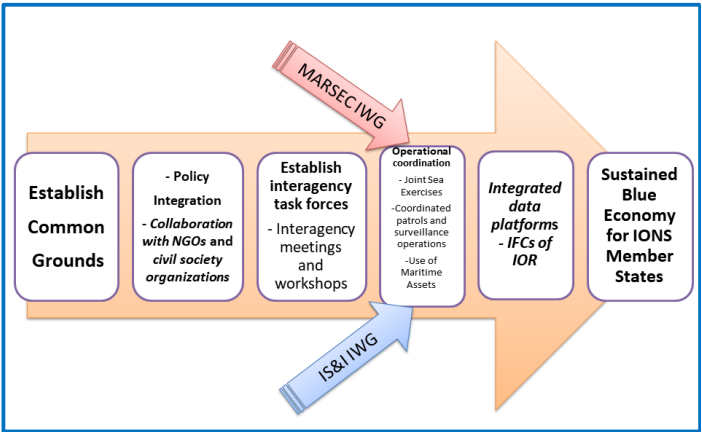
Integrated data platforms that compile information on maritime activities, including security incidents, environmental data and economic activities are to be utilized like the IFCs of IOR. 16 Real-time data sharing between agencies to enhance situational awareness and decision-making is to be ensured. It is also required to support joint research initiatives to gather data on marine ecosystems, resource availability and maritime threats. Monitoring systems that track the health of marine environments and the impact of human activities are to be implemented.
Again, collaboration with Non-Governmental Organizations (NGOs) is also vital. Collaboration with NGOs and civil society organizations to promote community involvement in maritime governance is to be considered. Therefore, by finding common grounds and integrating policy, operational coordination, data development and collaboration with nongovernmental actors, maritime security and Blue Economy initiatives can be effectively harmonized. This integrated approach will ensure sustainable, secure and prosperous use of maritime resources benefiting both the environment and the economies of the IONS member states.
Organizing Table Top Wargame (TTX)/ Command Post Exercise (CPX)/ Sea Exercises
Conceptualizing themes and mechanisms for Table-top exercises (TTX)/ Command Post Exercise (CPX)/ Sea Exercises, the MARSEC IWG involves a detailed plan that addresses the specific security challenges and objectives in the IOR.17 The MARSEC IWG can create detailed scenarios with realistic challenges that require coordinated responses and assign specific roles to participants (e.g., naval commanders, intelligence officers, legal advisors) to simulate real-world decision-making processes. Moreover, the working group can use facilitators to guide discussions, ensure engagement, keep the exercise focused on objectives and conduct debriefing sessions to identify lessons learned, best practices and areas for improvement.
Fostering the Culture of Innovation and Creativity
Understanding the motivations and tactics of "blue criminals" those engaged in Blue Crimes Is essential for effectively combating maritime security threats and protecting the Blue Economy. It is therefore; important to foster a culture of innovation and creativity among the junior leaders of IONS Navies to analyze the pattern of Blue Crimes and predict the foreseeable move by the Blue Criminals when they are misusing AI and modern technology and committing Blue Crimes. By understanding the motivations, methods and behaviors of blue criminals, IONS can enhance its ability to prevent and counter blue crimes and support Blue Economy effectively.
Critical Maritime Infrastructure Protection (CMIP)
Collaboration among IONS member states to protect Critical Maritime Infrastructures (CMIs) in the IOR is crucial to facilitating Blue Economy.18 This can include sharing data on suspicious vessels and conducting joint exercises and training programs focused on enhancing the capabilities of naval and maritime security forces in protecting CMIs. This can also involve simulating various security scenarios and practicing coordinated responses. Moreover, developing Standard Operating Procedures (SOP) for responding to security threats to CMIs may be considered. It is also important to raise awareness and involve Community Engagement among maritime stakeholders, including local communities and industries, about the importance of protecting CMIs and the role they can play in reporting suspicious activities.
Uniformed Actions by the IFCs
Information Sharing and Interoperability IONS Working Group (IS&I IWG) can take a lead role to bring unity of effort among the IFCs. Given the presence of three Information Fusion Centers (IFCs) in Singapore, India and Madagascar, IONS may ensure that these centers work cohesively to create a unified understanding of maritime trends and operational needs. IONS may facilitate the coordination of the three regional IFCs, ensuring they share intelligence, align their operational strategies and develop a common maritime situational awareness. This unified approach is vital for effectively monitoring and responding to maritime threats such as piracy, smuggling and illegal fishing. IONS may provide a platform for naval officers to build interpersonal relationships, fostering trust and understanding among navies. These relationships help establishing informal communication channels, which can be crucial for quick and efficient information sharing during maritime emergencies or coordinated operations. Thus, IONS can be instrumental in ensuring that the regional IFCs work synergistically towards shared maritime security goals. By fostering interpersonal relations, establishing informal communication channels and developing maritime security communities of practice, IONS can enhance the collective ability of regional navies to maintain a secure and stable maritime domain.
The Blue Task Basket
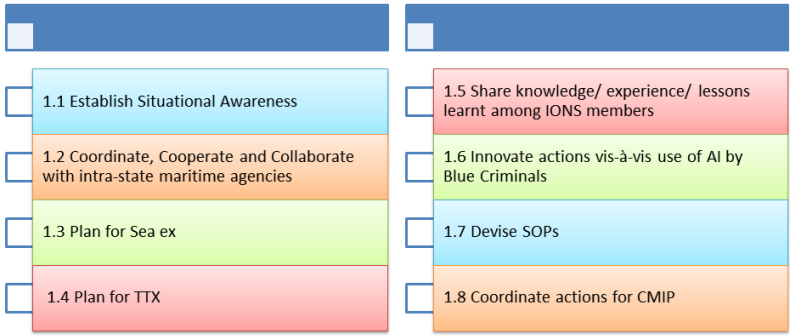
While acting sequentially the MARSEC IWG may work with a Blue Task Basket consists of the list of tasks to be addressed, which may include but is not limited to establishing situational awareness in coordination with the IFCs and coordinating, cooperate and collaborating with intra-state maritime agencies. The IWG may also consider tasks like planning sea exercises, TTX, sharing knowledge/ experience/ lessons learnt among IONS members. Moreover, other tasks may include innovating actions vis-à-vis the use of AI by Blue Criminals, devising SOPs and coordinating actions for Critical Maritime Infrastructure Protection (CMIP), etc. (Figure 3).
"Let Go"
Thailand being the incumbent chair of IONS leads a very important agenda of Blue Economy for sustainable development of IONS member states. As it is said that, ―Better late than never‖, the crux of the ongoing Essays of the IONS Essay competition may be discussed in the forthcoming IONS Symposium 2024 and the next Conclave of Chiefs. Moreover, the co-chair of the MARSEC IWG may actively consider working with the ‘Blue Task Basket’ steering the working group with The Plan ‘Blue’ for the sustainable blue growth of IONS member states.
Conclusion
The interconnections of MARSEC and the Blue Economy is crucial for the sustainable development of the Indian Ocean Region (IOR). The Blue Economy, encompassing diverse sectors such as fisheries, aquaculture and marine biotechnology, offers immense potential for economic growth and environmental sustainability. By promoting the sustainable use of ocean resources, it can significantly contribute to improved human wellbeing and social equity, while reducing environmental risks and ecological scarcities.
However, several challenges persist, including maritime security threats like piracy, armed robbery and illegal fishing, as well as environmental degradation, overfishing and resource depletion. Protecting Critical Maritime Infrastructure (CMI) is also vital for maintaining economic activities and ensuring resource safety. However, CMIs face a plethora of threats that must be effectively addressed to ensure their uninterrupted operation and contribution to the Blue Economy. Blue crimes such as piracy and smuggling threaten the security and integrity of CMIPs. Additionally, grey-zone activities, including cyber-attacks and sabotage by state or non-state actors, pose significant risks even if they fall short of open warfare. Terrorist attacks aimed at disrupting economic activities can cause widespread harm and insecurity. Moreover, accidental damage from ships or equipment malfunctions can disrupt operations and cause significant financial losses.
To effectively protect maritime infrastructures, there is a critical need for specialized and integrated approaches that recognize the unique challenges posed by the maritime environment. Modern technologies, including Artificial Intelligence (AI), present both opportunities and challenges in addressing these issues, necessitating innovative and proactive measures from maritime security practitioners.
Collaboration among IONS member states is essential to address these challenges and foster a prosperous and sustainable Blue Economy for IONS member states. Enhanced cooperation in Maritime Security (MARSEC) can create a stable and secure environment, attracting investments and promoting economic activities. The Blue Economy, in turn, generates revenue that can be reinvested into maritime security, creating a virtuous cycle of mutual reinforcement. Despite the benefits of integrating maritime security and Blue Economy initiatives, there remains a persistent dilemma due to the separate forums in which these discussions often occur. Bridging these gaps requires a comprehensive approach to ocean governance that includes both security and conservation perspectives. Aligning the perspectives of all maritime stakeholders of IONS member states towards a common goal can lead to more effective and sustainable outcomes.
The prospects for the Blue Economy in the IOR are promising, offering numerous opportunities for sustainable development and improved livelihoods. Realizing these opportunities requires overcoming significant challenges through coordinated efforts, capacity building and implementing best practices. Policymakers, stakeholders and researchers must coordinate, cooperate and collaborate to navigate the complexities of the Blue Economy and ensure inclusive and sustainable ocean governance.
Thailand, as the incumbent Chair of the Indian Ocean Naval Symposium (IONS), is performing an instrumental role in advancing the Blue Economy agenda for sustainable development among IONS member states. The proverb ―Better late than never‖ aptly encapsulates the urgency and timeliness of the Blue Economy initiatives within the IONS framework. Among the IONS working groups, the IONS Maritime Security Working Group (MARSEC IWG) may take the helm in addressing Blue Economy-related issues, particularly those termed as Blue Crimes. The MARSEC IWG, with its diverse representation from subregions of the IOR including South Asia, West Asia, East Africa, South East Asia and Australia, is well-positioned to address the complex and varied challenges associated with the Blue Economy.
To effectively address these challenges, each member state of the MARSEC IWG should focus on Blue Crimes sequentially, collaborating with the 'Blue Task Basket'. This initiative involves a comprehensive list of tasks to be addressed, ensuring that all relevant issues are considered methodically. Each IONS Navy needs to collaborate with the intra-state stakeholders, sharing their experiences and best practices with other IONS navies. This collaborative approach fosters a unified and cohesive strategy towards maritime security and the Blue Economy. To effectively address the challenges of the Blue Economy ground, the MARSEC IWG can create detailed scenarios for organizing Table Top Wargames (TTX), Command Post Exercises (CPX) and Sea Exercises. These exercises may present realistic challenges requiring coordinated responses and assigning specific roles to participants to simulate real-world decision-making processes.
Furthermore, the IONS Information Sharing and Interoperability Working Group (IS&I IWG) can provide crucial support to the MARSEC IWG. By streamlining the functions of Information Fusion Centres (IFCs) within the IOR, the IS&I IWG can enhance information sharing and interoperability among IONS member states. This improved communication and collaboration will significantly strengthen the collective efforts to address maritime security threats and promote sustainable Blue Economy practices. Fostering a culture of innovation and creativity among the junior leaders of IONS navies is equally important. By encouraging these leaders to analyze patterns of Blue Crimes and predict foreseeable moves by Blue Criminals—especially those misusing AI and modern technology—IONS can enhance its ability to prevent and counter these crimes in the prevailing dynamic maritime security scenario. Understanding the motivations, methods and behaviors of Blue Criminals will empower IONS to develop more effective strategies for safeguarding the Blue Economy.
By utilizing the 'Blue Task Basket', the co-chair of the MARSEC IWG can steer the group towards the ‗Plan Blue'—a comprehensive strategy aimed at promoting sustainable blue growth for the IONS member states. This plan focuses on key areas such as enhancing maritime governance, combating illegal activities, protecting marine ecosystems and fostering blue innovation and technology. Moreover, the essays from the ongoing IONS Essay Competition, reflecting a wide array of perspectives and innovative ideas, may provide a rich repository of insights that can be discussed at the forthcoming IONS Symposium 2024 and the next Conclave of Chiefs. These essays should be leveraged to stimulate constructive debates, identify best practices and foster collaborative strategies that align with the Blue economy goals of the IONS member states for sustainable development.
In conclusion, the IOR stands at a crossroads where integrating MARSEC and the Blue Economy can lead to a more prosperous and sustainable future. By fostering cooperation among IONS member states and adopting a holistic approach to Blue Economy, the region can harness the full potential of its ocean resources while safeguarding its ecological and economic stability. The continued efforts to strengthen MARSEC and promote sustainable Blue Economy practices will be pivotal in achieving long-term security, stability and prosperity in the IOR. Thailand's constructive discussions on Blue Economy and MARSEC in this regard are not just timely but essential, steering the IONS towards the Blue Growth.
Bibliography
- M. Gulam Hussain, Pierre Failler, A. Al Karim & M. Khurshed Alam. Major Opportunities of Blue Economy Development in Bangladesh. Journal of the Indian Ocean Region, 14:1, 88- 99, DOI: 10.1080/19480881.2017.1368250
- Christian Bueger and Timothy Edmunds. Beyond Sea blindness (2018). A New Agenda for Maritime Security Studies. International Affairs, Vol. 93, No. 6, 2017, p. 1293.
- Christian Bueger. (2023). Navies and the blue economy: Strategic thinking at Indian Ocean Naval Symposium. Keynote address at 8th IONS, Bangkok, 20 June 2023
- Christian Bueger. (2014). What is Maritime Security? Marine Policy, Vol. 53, 2015, p. 162
- Moutusi Islam. (2019). Maritime Security Challenges for Bangladesh: Response Options. BIISS Journal, Vol. 40, No. 3, July 2019: 269-290
- Pradeep, Chauhan, Vice Admiral, AVSM & Bar, VSM, IN (Ret.). (2016). The Criticality of the IONS Maritime Security Construct. Centre for International Maritime Security.
- Moutusi Islam. (2024). Blue Economy and Bangladesh: A Balanced Approach between Development and Conservation. Anasua Basu Ray Chaudhury and Harsh V. Pant, eds, Anchoring the Bay of Bengal in a Free and Open Indo-Pacific, (New Delhi: ORF and Global Policy Journal, 2024).
- Moutusi Islam and Lam-ya Mostaque. (2018). Blue Economy and Bangladesh: Lessons and Policy Implications. BIISS Journal, Vol. 39, No. 2, April 2018: 135-162
- Pradeep, Chauhan, Vice Admiral, AVSM & Bar, VSM, IN (Ret.). (2016). The Criticality of the IONS Maritime Security Construct. Centre for International Maritime Security. Available at: https://cimsec.org/tag/indian-ocean/page/3/ (Accessed: 16 June 2024).
- P.G. Patil, J. Virdin, C.S. Colgan, M.G. Hussain, P. Failler and T. Vegh. (2018). Toward a Blue Economy: A Pathway for Sustainable Growth in Bangladesh. Washington, DC: The World Bank Group.
- Gunter Pauli. (2010). The Blue Economy: 10 Years, 100 Innovations, 100 Million Jobs. Paradigm Publications, Taos, New Mexico, USA, 2010.
- Rahman, Rezaur. (2023). Promotion of Blue Economy in the Bay of Bengal, Maritime Security Challenges and the Role of BIMSTEC. Armed Forces Journal, Vol 5, Issue 1, Nov 2023. P 132-144.
- Voyer, M. et al. (2018). Maritime security and the Blue Economy: intersections and interdependencies in the Indian Ocean. Journal of the Indian Ocean Region 14 (1), pp28-48.
- Aparna Roy. (2019). Blue Economy in the Indian Ocean: Governance Perspectives for Sustainable Development in the Region. ORF Occasional Paper No. 181, January 2019, Observer Research Foundation.
- M. Golam Sharwar et al. (2023). Emerging Blue Economy for Bangladesh: Opportunities, Challenges and Way Forward. Bangladesh Maritime Journal Vol 7 Issue 1 ISSN 2519-5972.
- Voyer, M., Schofield, C., Azmi, K., Warner, R., McIlgorm, A. & Quirk, G. (2018). Maritime security and the Blue Economy: intersections and interdependencies in the Indian Ocean. Journal of the Indian Ocean Region, 1-21. https://www.academia.edu/61600742/Maritime_security_and_the_Blue_Economy_intersections_and_interdependencies_in_the_Indian_Ocean
- Abhijit Singh. (2023). Maritime Security in the Bay of Bengal: Obstacles and Opportunities. ORF Occasional Paper No. 437, May 2023, Observer Research Foundation.
- Sawan, R.S. (2020). Problems and prospects of maritime security cooperation in the Indian Ocean Region: a case study of the Indian Ocean Naval Symposium (IONS). Royal Australian Navy, Sea Power Sounding, Issue 15, 2020.
- Cordner, Lee. (2011). Progressing Maritime Security Cooperation in the Indian Ocean. Naval War College Review: Vol. 64: No. 4, Article 7.
- Upadhyaya, S. (2014). Maritime security cooperation in the Indian Ocean Region: The role of the Indian Navy. Australian Journal of Maritime & Ocean Affairs, 6(4), pp. 173-190.
- UNEP. (2011). Towards a Green Economy: Pathways to Sustainable Development and Poverty Eradication. https://www.unep.org/greeneconomy
- UNEP, FAO, IMO, UNDP, IUCN, Center, W. F., & GRID Arendal. (2012). Green Economy in a Blue World. Nairobi, Kenya: www.unep.org/greeneconomy and www.unep.org/regionalseas
- United Nations. (2014). Blue Economy Concept Paper. Paper presented at the Blue Economy Summit., Abu Dhabi, United Arab Emirates. https://sustainabledevelopment.un.org/content/documents/2978BEconcept.pdf
- Barry Buzan. (2009). People, States & Fear: An Agenda for International Security Studies in the Post-Cold War Era. ECPR Press, 2 edition, University of Essex, Colchester, UK; Reprint: 2009, p. 160
- C. Bueger and T. Liebetrau.(2023). Critical Maritime Infrastructure Protection: What’s the trouble? Marine Policy 155 (2023) 105772.
- S. K Mohanty, Priyadarshi Dash, Aastha Gupta and Pankhuri Gaur. (2015). Prospects of Blue Economy in the Indian Ocean. Research and Information System for Developing Countries, New Delhi, 2015.
- Michelle Voyer, Genevieve Quirk, Alistair McIlgorm, Kamal Azmi, Stuart Kaye and Michael McArthu. (2017). The Blue Economy in Australia. Canberra, Australia: Sea Power Centre, 2017
- Jennifer J. Silver, Noella Gray, Lisa Campbell, Luke Fairbanks and Rebecca Gruby. Blue Economy and Competing Discourses in International Oceans Governance. The Journal of Environment & Development, Vol. 24, No. 2, 2015, pp. 135-160
- BUZAN, B. 1983. People, States and Fear: An Agenda for International Security Studies in the Post-Cold War Era. Review of International Studies 24 (2): 133–34.