
MDA Challenges and Prospects of Information Sharing and Interoperability in IOR
Commander Hamed Ali Alfannah Alaraimi — Commanding Officer, RNOV Alshamikh — Royal Navy of Oman — Topic 6
Introduction
The Indian Ocean becoming more important than ever, It is one of the major commercial route for global trade and the world’s fastest growing regions with a valuable source of fishing and mineral resources. Over 90 Thousand vessels in the world’s commercial fleet transport over 10 BT per year which represents an increase in the volume of commercial shipping every year, The energy flows through the IOR are of particular importance, over 58 million barrels per day, equivalent to about 61% of the world’s oil supply travel through the entryways into and out of the Indian Ocean, including Strait of Hormuz, the Strait of Malacca and the Bab-el-Mandeb which are the world's most important strategic chokepoints by volume of oil transit.

The definition of the “Maritime Domain is all areas and things of, on, under, relating to, adjacent to, or bordering on a sea, ocean, or other navigable waterway, including all maritime related activities, infrastructure, people, cargo, and vessels and other conveyances, and the Maritime Domain Awareness is the effective understanding of anything associated with the maritime domain that could impact the security, safety, economy, or environment of any country”. MDA is a strategic solution that allows leaders at all levels of command to act quickly, timely and effectively with appropriate action against security threats that harm the interests of a country and their friendly nations. MDA will lead the region for more investments to make IOR more attractive and competitive, more secure, safer, environmentally cleaner. This paper will identify the MDA challenges and prospects in the scope of information sharing and the difficulties of interoperability in IOR as well as will illustrate a practical model to overcome those challenges and interoperability issues.
Security of the Indian Ocean Region (IOR) is vital to the operational needs and objectives of IOR countries, the MDA will cover all national and international water and adjacent areas. Although it is very hard to secure this huge area but with close relations, great collaboration, proper equipment and effective MDA solutions, it will be easy enough to secure the adjacent areas and Areas of Interest (AOI) from any security threats and environmental risks. The more we understand about our capacity and capabilities, our security threats and activities, and instant information, analysis and specific reports shared, the better decision making and ACTION will be taken to locate, ID, intercept any Target of Interest (TOI).
MDA Mission
The Mission of MDA is to enhance cooperation and collaboration, conduct effective Maritime Security Operations-MSO, increase information sharing coordination, develop capabilities, integrate with IONs organic systems and sensors in order to counter piracy, disrupt illegal maritime activities, mitigate maritime environment threats & risks to improve the maritime security in the region. This will require great efforts of planning, preparation and training.
MDA Objective
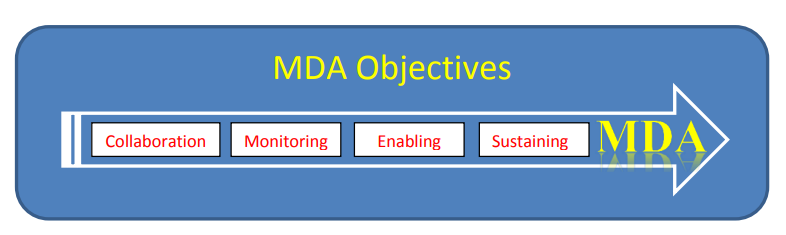
MDA objectives clearly depends on information sharing to monitor, identify, react and counter any security threats and activities, information is to be collected, filtered, analysed and assessed to enable leaders and decision makers easily counter security threats and anticipate future risks. Therefore, MDA will support to early identify Maritime Security threats, environmental risk and illegal activities in IOR and also around the globe. The following objectives will enhance the capabilities of IOR and when executed will provide effective information sharing and broad understanding of the IOR maritime domain:
- Collaboration and closer relation and coordination of IOR Navies.
- Enhancement of overall IONs monitoring and reporting capabilities, early detection and response, appropriate information sharing & Identification of security threats and environmental risks.
- Enabling IOR real-time and dynamic solutions, effective and prompt decision-making and anticipating future of maritime security threats.
- Sustainability to ensure IOR freedom of navigation and commerce.
MDA Challenges & Prospects
The maritime security threats and environments risks in our region are increasing with absent of proper monitoring and information sharing systems, in this accelerated information decade, the complexity of the threats needs more and effective collaboration, coordination, cooperation and communication. Indian Ocean Navies (IONs) must upgrade their operational capabilities and capacities effectiveness, provide effective training, adapt new procedures and policies, provide new information systems and technology, and get closer for better understanding and effective relation. We must develop our operational capabilities to counter present security threats while anticipating the future threats activities.
To achieve the roles and objectives of maritime domain awareness (MDA), efforts must be combined to achieve a comprehensive awareness of the overall challenges in the maritime security. The huge areas of the oceans and seas, long distances and coastlines with the absence of international and regional cooperation and collaboration to reduce maritime risks & challenges, is in itself a major challenge to reach a comprehensive awareness of the IOR maritime security. The key principle of achieve MDA challenges in maritime security is the effective information sharing and better understanding of all maritime risks, activities, events and trends which could threaten IOR countries safety, security, borders, environment and fisheries; such as piracy and armed robbery at sea, terrorism, illegal unreported and unregulated fishing, drugs & weapons smuggling, slave trading, human trafficking, environmental pollution, and disasters at sea.
Indian Ocean Navies (IONs) MDA primary prospective and strategic goal is to achieve the unity of efforts, enhance capability, share information and work closely together to strengthen their presence to achieve their objectives and ambitions to gain better maritime situational awareness of the regional and global maritime theater in order to achieve the requirements of maritime security operation-MSO, control and deny terrorist activities, piracy and other maritime security threats and environmental risks that seek to harm their interests.
IONs Maritime Operational Planning Challenges
Building and achieving economy of effort, operational capacity, respect for other partners opinions, and national laws and sovereignty of participating nations are an effective factors in the coalition planning phases. Maritime Operational Planning Process for IOR Navies will be faced with many challenges that require more attention and solutions prior conducting MSO operations. Some of these challenges are addressed bellow:
- Identifying the limitation and capabilities of the capacity, elements and resource based on operational requirements to employ maritime forces to patrol, monitor and ID any air, surface and subsurface targets in such a large sea areas.
- Identifying domestic maritime law of different claims in territorial and economic resources, physical boundary or clear jurisdiction in international waters and other boundary issues.
- Identifying maritime security threats that can exploit the IOR maritime environment.
- Limited maritime interoperability skills and training.
- Integration difficulties including operational planning and communications, information exchange and other interoperability issues.
- Limited opportunities to conduct multinational maritime MSO operations.
The Indian Ocean Navies (IONs) will make a significant contribution to the MDA in the form of:
- Strengthening their presence by effective collaborations and MSO operations.
- Exchanging and sharing information and intelligence gathered data by IONs forces deployed in the area.
- Analysing, filtering and sharing information equally and instantly to all IONs MSO centers..
- Establishing Command and control through centralised IONs Maritime HQ for all Maritime Security Operations-MSO against any security threats and risks.
- Strengthening regional and international relations to share information with global Maritime Partners and Stakeholders.
- Increase regional cooperation and collaboration by sharing experience skills and training programs.
IOR Maritime Engagement Towards Creating MDA CONOPS
Joint operation and cooperation with proper concept and mechanism of information sharing is the key for any successful operation and will eliminate any potential maritime security threats, another key factor in the success of any cooperation is also the importance of understanding and evaluating of all challenges to priorities and develop operational requirements to adopt effective MDA CONOPS. The efficiency of MDA, effectiveness of information sharing, availability of Assets and good cooperation in coordinating and harnessing all efforts among all IONs is the key for MDA CONOPS. It is therefore necessary to have effective and appropriate MDA CONOPS to expand and increase the cooperation and coordination, great understanding of maritime security threats and environmental risks to identify appropriate concept and mechanism for effective information sharing and exchange of experience skills.
Similarly, it is optimum to have a clear vision of identifying present and future operational requirements in order to assess challenges and capabilities, and broad understanding of MDA environment is vital key for a successful continuation of MSO. it is always known that maritime MDA CONOPS can be achieved by setting goals and objective, developing sound strategies, having appropriate capacity and building solid relationship and cooperation to achieve the MDA. Appropriate capacity building is often necessary to ensure successful maritime security operation-MSO, and proper compatibility and interoperability to ensure successful integration between operating systems and operating procedures will achieve effective MDA CONOPS. The diversity of maritime security threats, especially in a large area of seas and oceans makes us insist that continues cooperation and collaboration, building capabilities and capacity, having right policy and tools, understanding of maritime domain to deter any security threats and risks are the only solutions for MDA in order to provide appropriate means to help make the right decisions at the right location in a timely manner.
The MDA CONOPS will illustrate the effectiveness of contributions to IONs of Member States and stakeholders. The implementation of this concept of operations requires close coordination and good planning of all activities, operational tasks, policies and training to achieve the MDA effectiveness for decision-makers. This great effort does not only specify the ability or experience of IOR Navies, but also helps in the smooth implementation of the MDA CONOPS to accelerate the processes of making the appropriate and effective decision and provide efforts to reach the following:
- Proper and Early action requirements in the MDA theater.
- Establishing maritime awareness and better relations to reach a unified solution for the exchange of information.
- Identifying the challenges, obstacles and difficulties that hinder information sharing to obtain appropriate and adequate solutions to overcome them.
- Overcoming political & cultural barriers between countries in the exchange of information and intelligence reports.
- Adapting new operational, technical procedures and policies associated with the IOR MDA.
- Managing exchange mechanisms and prioritization, Identification, analyse and display of information and databases of MDA among all IOR partners.
- Implementing advance training and planning program on accelerating operational decision-making.
- Utilizing MDA to access the greatest amount of information in addition to continue future developing and upgrading process of systems.
- Establishing MDA information sharing and tools that capable of presenting strategic views, maritime situational awareness, command and control and operation requirements of the IONs forces.
MDA Information Sharing and Interoperability Approach
MDA Information sharing has become the key factor to the success of any mission and a major leap in the transformation data of accelerating activities for achieving the appropriate action, it is the best way to reach to the concept of MDA, therefore, the consolidation of strong coordination and cooperation in this area is crucial. But there are still other major challenges achieve this goal, the most important of which are the different strategies, policies, procedures and lows which can make it difficult to reach to that concept of MDA among the IONs forces. Adding to that the difference in systems, technology, protocols and others that would complicate systems compatibility and interoperability.
Efforts made towards establishing and maintaining and adequate level of MDA require a multinational, interagency and unity of effort. Currently international organizations, Navies, and law enforcement are only a few of the groups struggling to establish a global MDA capability. Just as diverse, the analytic resources needed to support MDA to achieve this effort in order to build a community of interest (COI) in MDA related analysis. This multinational groups will come from a variety of backgrounds with disparate analytic skills that need to be integrated in their support of MDA. Experience skill sets, agency representation, etc. should be part of an MDA analysis community, and have proper type of forum that is suitable to ensure the proposed initiatives do not fail.
The SHARP-MDA Model
I’ve studied the concept of a new MDA model approach to come up with a holistic approach to provide a robust capability to achieve MDA of IOR Navies. This model is called (SHARP=MDA), it is a five pillars constructive approach to developing maritime situational and domain awareness, it is structured to promote and support the participation and development of the following:
- Systems. To develop and enhance decision making merged with availability and instant distribution and sharing of information, interoperability technology to gain access to information that can be shared securely and equally to all IOR member & stakeholder anytime and anywhere.
- Human. To easily interact and intuit to build up experience and professionalism skills to avoid risks by displaying, analyzing and filtering information and can correlate and share correct and precise information in a useful, professional and user friendly fashion to help proper decision making to create effective maritime domain awareness.
- Assets. To collect, investigate, react, intercept and seize security threats and activities, and to be at the right time in the right location in order to act quickly and counter any threats, and be able to operate in a specific areas for a specific task with correct information to achieve economy of efforts and Objectives to protect IOR national interest and investment.
- Relations. That can ease coordination and strengthen cooperation to achieve effective collaboration between IOR Navies to facilitate closer partnership, sharing benefits and interests, solving challenges and problems.
- Procedures. That can governs laws, enforcement and defense to improve understanding and CONOPS, use of maritime environment aligned with international laws of the sea to set effective operating procedures & policies for proper information sharing and better understanding of MDA environment.
From the above, I would like to emphasize that, the strategic approach to IOR MDA and situational awareness will be only achieved by closely working effectively together to achieve our objectives, provide proper equipment and systems to share information, find proper tools for better integration, the bellow figure illustrate the MDA five Pillars:
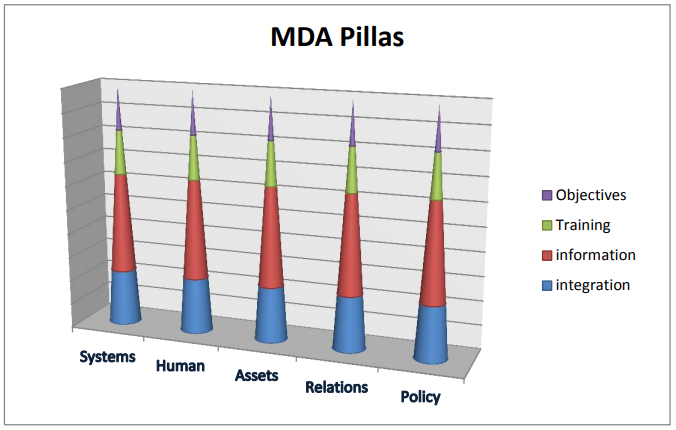
[SHARP] model supports the development of the technology to connect and share information between stakeholder, builds Human top performance and decision making capabilities, capacity of assets Focuses on specific area, enhance and foster relationship, cooperation and collaboration, helps development of policy and procedures that enables and smoothen operations. On the other hand, without proper integration and interoperability, valuable information, clear vision and objectives, MDA will never work and achieve its objectives, each component of (SHARP) is mutually supporting effective MDA, it will bring value to all five pillars by building interaction between all components, it will involve in great outreach activities with IOR Navies, security organizations, and other international allied partners, it also support the alignment of IOR governments activities through participation in governing organizations and business companies working toward effective and consistent implementation of maritime information sharing by developing management tools to keep key leader always informed of the situation.
The strategic approach of [SHARP] model is to focus of four rings (objectives, information, training and interoperability), where objective to always connected in mind in order to foster partnership, support shared interest, investments, benefits of information sharing, whereas information always the key governed aligned with effective policy and standard procedures to increase information sharing, it is always the core of MDA, and when it comes with training, it is clear and understood of how to value information and use it to increase benefits, relationship, overcome challenges, finally, interoperability remain the hop for the MDA Ad hoc network, it develops MDA process blueprint throughout the MDA lifecycle in order to make information always sharable, accessible, available for decision makers.
![Figure 4. [SHARP] Strategic approach](/wp-content/uploads/2026/07/Figure-4.-SHARP-Strategic-approach.png)
Technology provides the tools to implement sharing of information, rules and standards to be effective. Internationally, [SHARP] also engages IOR community to coordinate a shared vision of global MDA. The technology already exists and in our hands to give us most of the capabilities and the tools. The real challenge is in implementing it, the key is by strengthening relationships and cooperation, solving problems, reaching agreement on standards operating procedures and policies, and helping updating them to reach the development of effective maritime situational and domain awareness.
MDA Interoperability Support
MDA Interoperability is the capability of information sharing systems and the information they store to be exchanged and transferred to multinational IOR agencies stakeholder. Interoperability is addressed at different ways like information and data hardware and software, sensors integration, system & software management. involving connections of computer & communication systems and sensors using many multisystem interfaces and tools, the accessibility of all applications functions integration, managing and executing of data between others[ 5 ]. MDA will allow the IOR Navies to share and bring together everything from the audio/video to optical surveillance to web based application under the control of one shared MDA system online with established IONs. MDA strength will be only on achieving the following:
- Fully MDA interoperability of information sharing architecture.
- Fully MDA Systems and Data availability.
- Fully automation and allocation of application
- Fully MDA redundant system with zero delay and zero maintenance.
- Fully scalable, adaptable and expandable MDA system.
- Easily deployable and user friendly system.
- Fully independent from other hardware.
- Fully plug and play, COTS and cost effective.
MDA Information Analysis
I’ve mentioned earlier that in order to establish and maintain an appropriate level of MDA, it is required to have a considerable unity of efforts in collaboration and cooperation in maritime security. At the moment, efforts by international IOR Naval forces, Coast Guard and other maritime security organizations are only modest efforts to reach the creation of the regional and global capacity of MDA. Just as there is a diversity of MDA analytical resources to support this effort, there is also a need to build a community that is willing and interested in the relevant MDA analysis. I will address several aspects of this area as follows:
- Policies and Laws towards MDA. There is a requirement to review the common Policies, Procedures and Legal issues of the IOR countries. International participation and conferences will expand this discussion to include the range of challenges faced to reach MDA as follows:
- Identify legislation and jurisdiction that enable MDA to promote the regional and global maritime security
- Recommendations for stronger cooperation and coordination between IONs and the international maritime community.
- Identify challenges and legal gaps at the domestic and international lows in the implementation of maritime security operations.
- MDA in Territorial Seas. there is a need to examine and strengthen MDA cooperation and coordination to carry out MSO surface and air patrol within the territorial seas of IOR countries.
- High Seas of MDA. There is a requirement to consider and solve the issues and difficulties of MDA combined operations on the high seas.
- Counter Piracy & Terrorism. There is a need to consider the MDA requirements to counter Piracy & Terrorism operations and determine close relations with other International Security and Policing agencies to deter maritime security threats (weapons and drugs smuggling, illegal immigration and human trafficking.. etc.).
In order to achieve above mentioned MDA analysis requirements, there are also areas to be considered as follows:
- Develop future IOR requirements, Policies & procedures, Areas of improvements and future developments.
- Identify, coordinate and schedule the availabilities and capabilities of IOR maritime surveillance and patrolling assets.
- Process, analyse and utilize the availabilities and capabilities of IOR maritime sensors, information and intelligence sharing.
- Exploit and update of information to develop and disseminate the quality and the level of the decision-making.
- Identify Exchange of information protocols & procedures between IOR Navies and international maritime organizations.
- Execute training program, exercises planning to anticipate future MDA requirements and developments.
- Continue develop MDA solutions for solving errors and upgrading system for quick decision making process.
MDA Integration Challenges & Solutions
Maritime Domain Awareness-MDA is only achievable with increased, close, strong and continues relationships, cooperation, coordination, communication and collaboration among relevant IONs Members & stakeholders. Therefore, the first challenge is to overcome any relationship barriers by having clear and open minded and constructive dialogue and discussion. The second challenge is a proper and full interoperability surveillance and picture compilation components off the shelf (COTS) information sharing systems that can be integrated and configured easily with multisystem architecture towards full interoperability and availability assurance in order to be able to Locate, Identify, Process, Asses and Analyses information ready to be distributed quickly and timely to all IONs Members & stakeholders.
The European Commissioner for Maritime Affairs and Fisheries Joe Borg said:
this highlights the importance of MDA and information sharing in shaping the future combined maritime security operation-MSO in the maritime domain to enhance security cooperation and maritime situational awareness in order to achieve domain awareness of all activities at sea combined with law enforcement to facilitate sound and prompt decisive actions. The third challenge is the capacity and availability of assets that can receive information and act accordingly to counter deny any security threats and activities, environmental risks and other illegal issues. The Fourth challenge is understanding of MDA environment between multinational maritime operators which can be solved with cross integration training seminar and exercises in the MDA within the region. The final challenge is working on same rules and policy and this can be achieved by agreed SOPs and effective CONOPS.
MDA Integration Requirements for IOR Navies and Security Agencies
The Integration has become an important issue in the development of combined MDA structure. The different in surveillance Systems, Policies and platforms have become more complex and sophisticated, and on other hand, they are provided by many number of different companies. With this increasing complexity, there is also an increasing requirements for systems integration. This means that the traditional cooperation and thoughts has to be replaced by a more willing, open minded and wide understanding collaboration between IOR Navies and other stakeholders. Without a collaborative, closer and stronger relationship, MDA will never move ahead and achieve the objectives, because collaboration is the only step towards the unified integration approach, it is the key for any combined operation and information sharing. Policies and technologies are other tools enabling MDA network to work better. In order to achieve this vision, IOR Navies should increase coordination, cooperation and enhance their relationship by increased of information sharing, training, combined exercises and planning.
IONs HQ Organisation & Levels of MDA
The commander of IONs HQ command will be circulated among the IOR Navies. The normal IONs Fleet Organisation will be as follows:
- Manpower and Personnel (N1).
- Operations for Information Dominance (N2/N6).
- Operations, Plans and Policy (N3/N5).
- Readiness and Logistics (N4).
- Communications, IT and Warfare Requirements (N6/N7)
- Resources, Assessments and Oceanography (N8)
- Finance and Training (N9)
- Civil/Military Operation (N10)
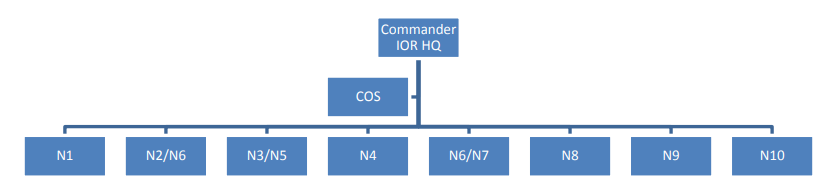
Organising the ION main command and control headquarters to achieve centralised information sharing and the complexity of MSO operations should be at the top priority of IOR countries due to the large ocean area and the amount of security activities, also the level of coordination, collaboration and relationship to be at the top strongest level and driven to specific mission. Therefore, the combined HQ should be utilized to coordinate the following three types of missions:
- Ongoing Coordination. Continue with existing maritime security operations, regional, and bilateral cooperation to counter piracy, armed robbery, and in time of crisis, coordination should be raised to appropriate strategic level to accommodate greater multinational as well as interagency cooperation.
- Contingency Coordination. Immediate activation of maritime security operations requires immediate actions due to time constraints, and might raise the coordination mechanisms to facilitate multinational efforts to achieve economy of effort for coordinating multinational operations to support MSO mission and information sharing.
- Multinational Cooperation. Full scale HQ organisation. Coordinating very complex maritime security operations and crises management and primarily focus on high risk areas and long MSO operations.
MDA support decision makers and leaders at all levels of command to be able to make effective and instant decisions to deter or counter any security threats, MDA always connected to provide decision makers with early, prompt and effective information in order to identify, select, and execute the most appropriate action to any urgent security threats according to strategic directive, operational control, or tactical deployment.
MDA at Strategic Level
At the strategic level, MDA provides to IONs efforts to shape the IOR security environment. This will be occurred through effective collaboration and participation in Maritime Security Operation-MSO to facilitate IOR Navies to achieve the superiority in maritime security and safety in the region with full acceptance of that all IOR members share the same objectives. Understanding and incorporating maritime security efforts and objective in IOR MDA to obtain effective coordination, cooperation and collaboration that set the principle to support legal use and prevent illegal activities of the IOR maritime domain.
MDA will contribute and help to build IONs capacity and capability in maritime security and safety, providing technical, equipment and training advices for participation in MDA networks to get useful and prompt maritime information ready at all time to be shared Regionally and globally, the concept is that IONs to share information and intelligence at all classification levels with appropriate IOR members, overcoming all barriers and challenges that inhibit MDA from sharing information with IOR members and security agencies to maximize the amount of maritime information, and directly contributing and participating in the MDA. On the other hand, building and increasing coordination is also very important to improve our capabilities, bilateral and multilateral information sharing is based on closer relationships at the strategic level, which is fundamental to IONs ability to gather and release classified and unclassified security information.
Instance and automatic access of information will require agreement on shared protocol and standards that exchange maritime information and data sources into a common information environment that is available to all IONs MSO centers at all level of command to access and create user defined Common Operational Picture-COP to classified and unclassified information means that, two user defined COP will be both in all IONs MSO centers to allow them the accessing ability to customise a single or combined (COP) of relevant information taken from other IONs or maritime security agencies.
MDA at Operational Level
At the operational level, the IONs Component Commander and IONs HQ Staff will be the focal point of command. Information at this level has multiple factors and concepts, because MDA information during a security threat differs from information needed for environmental risks, disaster relief or humanitarian assistance. MSO Centres will support and enable quick decision-making in response to sudden security threats. Effectiveness and efficiency of IONs Maritime Security Operations Centres, and other security agencies and resources, will work together operationally to penetrate and deter intrusion threats to MDA surveillance areas. Developing and understanding regional security threats and activities, to provide IONs decision-makers with appropriate information and knowledge, will require significant specialized training capabilities and automated, easily integrated information sharing.
MDA at Tactical Level
At the Tactical Level, the increasing and the growth of security threats in the maritime domain means that IONs Ships will require to operate widely to coordinate efforts with less capabilities. Therefore, integrating MDA with accurate situational awareness information and capabilities will allow IONs Ships and other commanders to assess and acquire any security threat and activities timely, accurately in the maritime environments, acting quickly to any tactical situations rather than waiting for accurate information or responding after the incident in order to have the advantage over any security threats achieved by surprise interception. IONs Ships and Aircraft, and shore establishments continuously gather information in their operating environment, optimizing it for investigation and positive identification of any suspicious behavior through integration of information with other IONs Ships at the tactical level. The implementation of MDA at the tactical level for the efficiently and effectively information sharing is dependent on organic establishments, ships and aircrafts surveillance systems and sensors including additional information gathered from other resources at the upper operational and strategic levels of MDA.
The development of MDA and IONs multilateral maritime information sharing systems will make a tremendous amounts of information availability, combined of organic information systems and sensors with gathered information will provide tactical level decision makers with more understanding of their maritime domain security activities and environmental risks, and improving the capabilities and capacity building of IONs at the tactical level will defiantly improve and use MDA automation and the process of integrating these multiple system capabilities. The objective of this level is to support and provide user the ability to access information associated with any threat in an integrated and user defined displays, regardless where it comes from.
MDA SATCOM
MDA Satcom will provides information from most IOR countries Military and commercial satellites. The integrated of multi-sensor will keep IOR Navies at the cutting edge of advanced information sharing solutions, and offers support to MSO Centers, Disaster Management Center, MDA decision makers, and other users of satellite information within IOR.
Internet accessibility and web-based databases, Mobile communication, will allow MDA to distribute information so that it is accessible to all IOR Navies and Security Agenesis at the same time, quickly and easily with a cost effective approach. MDA will support and enhance decision makers on maritime security activities, disaster management, detection and tracking of maritime environment risks.
MDA COMPLAN
MDA Tactical Communications will provide continues coverage to at the scene commander in the ranges of HF, UHF and VHF (Data and Voice), These circuits will be provided in accordance with MDA communication plan (allocation of frequencies and Designators to be discussed among the IOR planned meetings).
MDA Portal
MDA portal is the IOR internet gate of instant information sharing, decision makers will access information timely while meeting other strategic objectives and establishing a standardized information sharing system for all IOR Navies, the portal should be giving the following:
- Tools. accessed online by authentication (username and password) and to be included but not limited to the file sharing, MDA Surv (maritime traffic, AIS, LRIT..etc), VPN and webmail (example; outlook, skype for business).
- News and reports.
- Secured file transfer.
| Tools | Events / News | FTP |
|---|---|---|
| MDA Cloud | Media, Audio and Video | Secure File Transfer |
| MDA Surv | Reports | |
| MDA File Sharing | Articles | |
| MDA VPN & Webmail | Research Papers |
MDA Maritime Assets for Information Sharing
IONs fleet will be compromised from different types of platforms, aircrafts, UAV of Naval forces, Coast Guard and other establishments systems and sensors, maritime information will be available and accessible for operation IONs HQ Commander, MSO Operational Command will remain under respective Naval Commander of IONs. The Roles of IONs fleet are as follows:
- MSO operation, combat maritime security threats and other illegal activities, such as hijacking, piracy, illegal fishing, illegal human trafficking and drugs and weapons trafficking..etc.
- SAR, assist seafaring vessels in distress, plane crashes and medical evacuation.
- Marine environmental protection for a safer and green environment.
Training & Exercise Planning and Conferences
In order to achieve above mission and continue closer relation and cooperation, IOR Navies should to focus of on working together in the IOR environment, sharing information, knowledge, experience and skills, conduct more training to put them into practice by executing exercises that involve elements and series of MSO, SAR events. By exercising together on a regular basis, ION procedures and tactics will be clearly understood by all of the Naval forces participating in the exercises and training achieving valuable lessons regarding MSO procedures, Force protection, communications procedures and better integration between the different types ships and aircraft.
MSO SOPs
Maritime Security Operation-MSO SOPs is very important to be carefully studied to identify any planning factors. In order to ensure effective MSO, IONs are required to think of incorporating and establishing a multinational command and control HQ, organizational, coordination, coalition structures, capacity and capability requirements. There are many areas and issues to be identified, the following are some factors of many to adhered:
- Collaboration & Cooperation. Primary factor for ION and other maritime agencies is the international collaborative & cooperative efforts between strategic levels of IOR countries and other maritime organizations.
- Maritime Law Enforcement. There are many factors of maritime legal issues, which include taking action on either a law enforcement or national security, therefore, clarifying multinational legal authorities is important for appropriate and effective MSO operation and execution. Exercising legal authority and the jurisdiction by international law to take certain actions against any security threats, as follows:
- Modify authority in some ways by provisions within international law to have the power to act.
- Exercise jurisdiction authority over persons, vessels, and territory. In the maritime law enforcement, jurisdiction to have three elements (Substantive law, Vessel status/flag and Location) before taking law enforcement action.
- Have multilateral agreements to expand and add jurisdiction to provide a nation with a basis of authority for predetermined actions.
- Identify and define limits of each nation’s authority and jurisdiction to describe clearly common procedures when considering MSO planning.
- Capacity Building. IOR countries should have the proper and effective maritime capabilities in both military and civil organizations to response to any maritime security activity to secure maritime domain.
- MDA Information Sharing. Information sharing of the maritime domain, including the ability of displaying threat analysis, requires the establishment of a common protocols and standards to exchange and sharing information, to all IOR countries and maritime agencies and stakeholders and other international organizations and commercial institutions.
- Instant Decision-Making. SOPs, Policies and Legal authorities will support ION HQ instant decision-making, involving also the military strategic and operational level and other maritime organizations.
In order to safe multinational efforts, I recommend four priority milestones as the foundation for MSO SOPs, these milestone points (kick off points) are guide to connect each other and work together to achieve the effective communication and economy of efforts, these are as follows:
- IOR President (Leadership and Relationship). Strategic liaison on behave of member nations.
- IOR HQ (Organisation). IOR command, Operation Staff (N1 to N10), media (National & International).
- Command & Control (Coordination and information Sharing). Two command and control for each nation (National & Multinational).
- Joint Operation and Planning (Decision making). During planning and crisis process.
In addition of that I also recommend to look at the Multinational publications which provide a common set of doctrine for use in multinational operations. The table below contains information on multinational publications and other maritime tactics, techniques, and procedures (TTPs)
| Publication | Title |
|---|---|
| ADivP 1(A)/MDivP 1(A) | Multinational Guide to Diving Operations |
| ADivP 2(A)/MDivP 2(A) | Multinational Guide to Diving Medical Disorders |
| ALP 4.1 | Multinational Maritime Force Logistics |
| APP 2(F)/MPP 2(F) Vol I | Helicopter Operations From Ships Other Than Aircraft Carriers (HOSTAC) (Maritime VSTOL Data Included) |
| APP 2(F)/MPP 2(F) Vol II | Helicopter Operations From Ships Other Than Aircraft Carriers (HOSTAC) Technical Supplement |
| APP 7(B) | Joint Brevity Words Publication |
| ATP 16(D)/MTP 16(D) | Replenishment at Sea |
| ATP 2(B) Vol I | Naval Co-operation and Guidance for Shipping Manual (NCAGS) |
| ATP 3.4.1.1 | Peace Support Operations Techniques and Procedures |
| ATP 43(B)/MTP 43(B) | Ship-to-Ship Towing |
| ATP 57(A)/MTP 57(A) | The Submarine Rescue Manual |
| ATP 71 | Allied Maritime Interdiction Operations |
| AXP 3(C) | Allied Naval Communication Exercises |
| EXTAC 1004 | Voice Procedures and Brevity Codewords |
| EXTAC 1006 | Structured Messages |
| EXTAC 1010 | Rev A Noncombatant Evacuation Operations (NEO) |
| EXTAC 1011 | Naval Humanitarian Assistance Missions |
| EXTAC 1014 | Meteorological Support Manual |
| MTP 1(D) Vol I | Multinational Maritime Tactical Instructions and Procedures |
| MTP 1(D) Vol II | Multinational Maritime Tactical Signal and Manoeuvring Book |
| MTP 24(C) Vol I | Naval Mine Countermeasures Tactics and Execution |
| MTP 6(C) Vol I | Naval Mine Warfare Principles |
| MTP 6(C) Vol II | Naval Mine Countermeasures Operations, Planning, and Evaluation |
| MXP 1(D) | Multinational Submarine and Anti-submarine Exercise Manual |
| MXP 2(C) | The Multinational Maritime Above Water Warfare Exercise Manual |
| PCP 1(A) | Partnership for Peace Naval and Maritime Air Communications |
These fall into the following publication families:
- Allied Publications (ADiv, ALP, APP, ATP, AXP)
- Multinational Publications (MDiv, MLP, MPP. MTP, MXP, EXTAC)
- Partnership for Peace Publications (PCP)
- Helicopter Operations from Ships Other Than Aircraft Carriers (HOSTAC)
- Vertical/Short Take-off and Landing (VSTOL)
International Military and Civilian Cooperation & Collaboration
In my opinion, to achieve a holistic MDA approach, IONs should also assess the requirement for information sharing globally bringing together military forces as well as civilian organisation in order to get involve a unified and a cost effective solution to achieve a comprehensive Maritime Domain Awareness-MDA, to make IOR more attractive and competitive, more secure, safer, environmentally cleaner, this will defiantly require a well cooperated, coordinated, collaborated approach based on the instant exchange of information sharing, maritime surveillance, monitoring and reporting with full respect of applicable MDA policies and regulations.
Conclusion
MDA in this information driven decade is much easier, because of the availability of the advanced technology and fast information. In the future, it will be much more faster and advance. Today deployed maritime forces are the key component of any nation and only advance information sharing concept and mechanism will make combined forces work together, better and stronger to achieve greater performance, better mission analysis, expedite action deterrence.
From the above, it is clearly identified that MDA becomes vital to any Nation (Nations), Having proper tools, proper set of policies, procedures, experience and training skills accompanied with strategic vision and ambition, MSO activities will be much more identified, controlled and deterred, the operational effectiveness of the combined forces and understanding all maritime activities along with appropriate information sharing technology that linked with effective Maritime Domain Awareness-MDA will defiantly raise the situational awareness of IONs and will acquire needed information and provide a near-real time solutions to quickly respond to counter any maritime security threats and activities in the region.
This paper has illustrated the important of MDA by focusing on the capabilities and the interoperability requirements to achieve maritime domain awareness-MDA for IOR countries, the operational requirements of IONs can be mapped to bring the right technologies for the right purposes at the right location, especially in the areas of focused and high risks and security threats to enable data acquisition, dynamic decision support, and provide the optimal tools for IONs dealing with the maritime domain awareness challenge. Focusing to our operational and technical objectives on the functional requirements for achieving MDA to ensure that the IOR vision of achieving comprehensive maritime domain awareness-CMDA can be possible, having IOR safe and secure and competitive for more open global investment and economy.
Figures
- Commercial Routes
- MDA Objectives
- MDA Constructive Approach
- [SHARP] Strategic Approach
- IONs HQ Command Organisation
- MDA Portal
- Multinational Publications
References
- http://unctad.org/en/PublicationsLibrary/rmt2015_en.pdfReview of Maritime Transport 2015.
- https://www.eia.gov/beta/international/regionstopics.cfm?RegionTopicID=WOTC WORLD OIL TRANSIT CHOKEPOINTS..
- https://upload.wikimedia.org/wikipedia/commons/3/39/Shipping_routes_red_black.pngCommercial routes.
- https://arxiv.org/ftp/arxiv/papers/1107/1107.5397.pdfPROPOSED INFORMATION SHARING SECURITY APPROACH FOR SECURITY PERSONNELS, Md.Headayetullah , G.K. Pradhan, Sanjay Biswas , B. Puthalm.
- Headayetullah, Md., G.K. Pradhan, Sanjay Biswas, and B. Puthal. "Proposed Information Sharing Security Approach for Security Personnels." https://arxiv.org/ftp/arxiv/papers/1107/1107.5397.pdf.
- http://www.sldinfo.com/a-european-union-focus-on-maritime-surveillance/A EUROPEAN UNION FOCUS ON MARITIME SURVEILLANCE, Posted December 8th.
- http://www.dtic.mil/doctrine/new_pubs/jp3_16.pdfJoint Publication 3-16, Multinational Operations.
- https://wss.apan.org/432/TE31Files/MNF_SOP_and_Extracts/MNF_SOP_Ver_3.1_Maritime_Security_Operations_extract.pdfMULTINATIONAL FORCE STANDING OPERATING PROCEDURES, Version 3.1.