
IONS Towards Effective HADR Operations: IMMSAREX-2017 in Perspective
Commander Mohammad Shamsul Haque — Bangladesh Navy — Pen Name: Blue Whale
Introduction
Humanitarian Assistance and Disaster Relief (HADR) aims to relieve suffering due to the occurrence of a disaster and to aid in recovery. HADR is now considered and accepted as a legitimate defence mission across the world and these missions are a step towards binding the nations closer together to meet the growing threat of disasters and respond to adverse humanitarian events. These missions are the lowest common denominator of military cooperation, but the potential benefits are closer patterns of cooperation, opening of lines of communications between countries in the region, and professional dialogue between military forces.
HADR issues demand special attention by countries of Indian Ocean Region (IOR) as the region is prone to natural disasters and every year significant damages occur due to natural calamities. In this situation IONS navies have roles to play as HADR Operations in IOR have maritime dimensions in most cases. Though, IONS navies have come much closer since its inception in 2008, time has come to evolve some kind of more functional mechanism to deal with the HADR related activities successfully. The recently concluded exercise on HADR Operation IONS Multilateral Maritime Search and Rescue Exercise (IMMSAREX) - 2017 was a timely initiative in that sense that aimed to bring the member countries together to collectively carry out HADR missions.
This essay aims to analyze in short the vulnerability of IOR to natural disasters and relevance of IONS navies in dealing HADR issues in the region. It will then analyse the conduct of IMMSAREX-2017 to draw pertinent lessons on HADR. The essay will finally highlight on factors to be considered to achieve more functionalism in HADR Operations by IONS and discuss few major challenges that need to be negotiated.
Aim
The aim of this essay is to study on how to develop a more functional mechanism by IONS navies to deal with HADR issues taking lessons from recently concluded IMMSAREX-2017.
Vulnerability Assessment of the IOR
Beside human conflict, Natural Disasters have become a significant threat to world peace and stability. More than seven trillion US dollars of economic damage and eight million deaths via natural disasters have been recorded since the start of the 20th century. The number of natural disasters around the world has increased by more than four times in the last 20 years, according to a report released by the British charity Oxfam. It is found that the earth is currently experiencing approximately 500 natural disasters per year, compared with 120 per year in the early 1980s. The number of weather-related disasters in 2015 was 240, compared with 60 in 1980.
Disasters in IOR
Recent history has had no shortage of large-scale natural disasters, especially in the IOR. The devastating Tsunami in December 2004 killed about 275,000 people and left nearly 10 million homeless in Indonesia, India and Sri Lanka. It remains one of the most catastrophic natural disasters in modern history. Bangladesh, India and Myanmar are often hit by severe weather during the monsoon season, from the middle to the end of the year. Cyclone ‘RUANU’ hit coastal Bangladesh in 2016, leaving at least 24 people dead and several hundreds homeless. Severe Cyclonic Storm ‘MORA’ caused widespread impacts by devastation and severe flooding across Sri Lanka, Andaman and Nicobar Islands, Bangladesh, Myanmar and Northeast India in May 2017.
Following tables shows all storms in the 2017 North Indian Ocean cyclone season and their effects, which signify the vulnerability of IOR countries in general from natural disasters:
| Name | Date Active | Peak Classification | Sustained Wind Speed | Areas Affected | Damage (US $) | Deaths |
|---|---|---|---|---|---|---|
| Maarutha | April 15 – 17 | Cyclonic storm | 75 km/h (45 mph) | Myanmar, Andaman and Nicobar Islands, Thailand, Yunnan | $23.4 thousand | 4 |
| BOB 04 | July 18 – 19 | Depression | 45 km/h (30 mph) | Orissa, Madhya Pradesh, Chhattisgarh | $34.3 million | 7 |
| BOB 03 | June 11 – 13 | Deep depression | 55 km/h (35 mph) | Northeast India, Bangladesh | $223 million | 170 |
| Ockhi | November 29 – December 6 | Very severe cyclonic storm | 155 km/h (100 mph) | Andaman & Nicobar Islands, Sri Lanka, India, Maldives, Lakshadweep | $444 million | 74 |
| Mora | May 28 – 31 | Severe cyclonic storm | 110 km/h (70 mph) | Sri Lanka, Andaman and Nicobar Islands, East India, Northeast India, Bangladesh, Myanmar, Bhutan, Tibet | $1.36 billion | 135 |
| LAND 01 | July 26 – 27 | Depression | 45 km/h (30 mph) | West Bengal, Jharkhand, Madhya Pradesh | $2.19 billion | 152 |
| LAND 02 | October 8 – 10 | Deep depression | 55 km/h (35 mph) | Bangladesh, West Bengal, Jharkhand, Odisha, Andhra Pradesh | Not known | 7 |
| BOB 05 | October 18 – 22 | Depression | 45 km/h (30 mph) | Odisha, West Bengal, Northeast India, Bangladesh | Not known | 1 |
| BOB 06 | November 15 – 17 | Depression | 45 km/h (30 mph) | Odisha, West Bengal, Andhra Pradesh | Not known | 20 |
| BOB 08 | December 5 – 9 | Deep depression | 60 km/h (40 mph) | Southern Thailand, Northern Malaysia, Aceh, Andaman and Nicobar Islands, Odisha | Not known | 20 |
| 10 systems (Season total) | April 15 – Season ongoing | — | 155 km/h (100 mph) | — | $3.81 billion | 563 |
The Vulnerability
The Indian Ocean Region (IOR) is one of the most affected areas due to natural disasters. The countries and regions in and around the IOR constitute around 50 states with a total land-area of 33 million sq. km. These states and regions accommodate about 2.6 billion or 39% of the global population. The Indian Ocean occupies about 20% of the total ocean area of the world which covers a total of 73,427,000 sq km of the globe stretching from East-Africa to west-Australia- a distance of about 6,400 km or 4000 miles from west to east and from south Asia to Antarctica in North-South Orientation. The Oceanic islands and littoral countries are thickly populated and at the same time these maritime regions are greatly vulnerable to different types of natural disasters with varied nature and differentiated effects.
Considering the large population in coastal areas of heavily populated countries like, India, Bangladesh, Myanmar, Sri Lanka, Madagascar, Mauritius, Seychelles, a high proportion of people are prone to disasters, especially related by sea such as cyclone and tsunami. In addition to the threat to peoples’ lives, the stability of economy is also tied to coastal areas of these countries for many reasons. Moreover, the rise of sea level may affect the region within an era. All these circumstances and projections render the region vulnerable to disasters and make the conduct of HADR operations inevitable. The following figure shows the extent of damage caused by Cyclone ‘NARGIS’ alone in early May 2008 in Myanmar.

IMMSAREX-2017 Experience
Scenario of the Exercise
From the experience in the past, it was realized that HADR Operations involving multiple nations comes with technical, tactical and cultural challenges. Hence, IONS countries needed to enhance interoperability in terms of communication, information sharing and operating procedures. IONS, being an inclusive maritime cooperation construct, prudently embarked on a cooperative agenda in this regard. The first ever IMMSAREX-2017 aimed to make humble effort to realise the collective Maritime Search and Rescue (MSAR) through this exercise. The learning experience and improved liaison between the IONS maritime agencies would pave the way for a safer Indian Ocean in future. IMMSAREX-2017 was conducted from 25 to 29 November 2017 in Bangladesh and it was conducted in 3 areas by 3 TGs on following scenarios:
- Rendering Assistance to a Merchant Ship under Major Fire at Sea.
- Coordinated SAR for Missing Fishing Trawler and Crew.
- Search for an Aircraft Lost over Sea.
Exercise Grouping
Based on the scenarios, ships of the participating countries were divided into three groups, which are shown below:
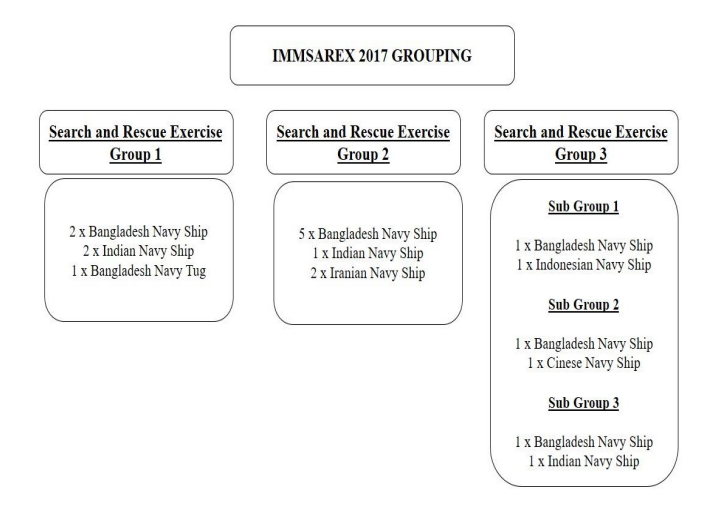
Exercise Set Up
There were three scenarios for the IMMSAREX. They will be discussed to draw relevant lessons in subsequent paragraphs.
Scenario-1. The objective of this exercise was to practice collective SAR procedure by multiple assets of IOR littorals in case of fire incident on board a merchant ship at sea. The exercise was conducted by SAREX Group 1 in following manner:
- A medium container carrier was simulated as distressed merchant ship that caught major fire in area under jurisdiction of MRCC (Maritime Rescue Coordination Centre) Dhaka. The distressed ship sent an SOS call earlier.
- Considering the gravity and location of the incident, MRCC Dhaka requested IONS Chairman for an effective MSAR. IONS Chairman requested member countries to participate in the rescue operation.
- Commander BN (Bangladesh Navy) Fleet was nominated as SMC (Search Mission Coordinator).
- The SMC planned firefighting, rescue and assistance to the distressed vessel and her crew.
- The OSC (On Scene Commander) (predetermined in this case) provided necessary information to SRUs (Search and Rescue Units) through a message as per IAMSAR (International Aeronautical and Maritime Search and Rescue) Manual, 2016; Volume III to execute the planned firefighting/rescue.
- The OSC designated SRUs for firefighting, rescue of crew, providing technical support and medical assistance.
- Patients were given first aid onboard designated ship. Some critically injured patients were evacuated to shore facilities by helicopter/ship.
- Distressed vessel was towed to the nearest anchorage/port facility by a suitable ship.
Scenario-2. The objective of this exercise was to practice and develop coordinated and quick response procedure by multiple assets of IOR littorals in case of lost fishing trawlers and/or crew at sea. The exercise was conducted by SAREX Group 2 in following manner:
- A simulated tropical revolving cyclone occurred on 25 November 2017 due to deep convection in the Northern Bay of Bengal (simulated). Sea became very rough within a short notice leaving insignificant time for the fishing trawlers to proceed to shelter. Consequent upon the said cyclonic storm, few fishing trawlers owned by multiple nations of IOR would reportedly be lost in the Northern Bay on 26 November. It would also be reported that some of the crew had been missing from the stranded boats/trawlers.
- On receiving the reports of missing trawlers, the Cox’s Bazar District Administration would request a SAR effort to MRCC Dhaka.
- IONS Chairman took initiative to conduct Multilateral MSAR and would invite IOR littorals to join the operation.
- Commander BN Fleet was nominated as SMC.
- OSC (predetermined) provided necessary information to SRUs through a message as per IAMSAR Manual, 2016; Volume III to execute the planned MSAR.
- SRUs proceeded to the designated search area.
- Initially SRUs discovered a disabled fishing trawler with few injured crew and dead bodies.
- First aid was provided and critical patients were shifted to shore facilities by a suitable ship/helicopter.
- Technical assistance was provided and efforts were made to tow the trawler up to shore facility.
- Information of 15 missing crew/fishermen were reported further.
- SRUs resumed SAR for the missing crew.
- First aid and/or MEDEVAC was carried out as necessary.
Scenario-3. The objective of this exercise was to practice and develop coordinated and sequential response procedure by multiple assets of IOR littorals in case of lost/ditched aircraft at sea. The exercise was conducted by SAREX Group 3 in following manner:
- International Civil Aviation Organization (ICAO) declared (simulated) an international passenger aircraft missing in flight. A distress signal was transmitted by a fishing trawler having seen an aircraft ditching into the sea. MRCC Chennai picked up the distress signal and subsequently informed MRCC Dhaka, as the location was under MRCC Dhaka’s jurisdiction. On receiving the request from MRCC Dhaka, IONS Chairman urged for an immediate response and IONS countries volunteered to conduct a SAR mission in the general area of the incident.
- MPA was airborne to conduct preliminary MSAR. The general search area was then segmented into three sub areas based on MPA report.
- Commander BN Fleet was nominated as SMC.
- SRUs were divided into 3 sub-groups to search in three various search boxes.
- Upon detection and recovery, aircraft debris and dead bodies (simulated) were shifted to suitable ship for onward disposal.
- First aid was provided and critical patients were evacuated to shore facilities by a suitable ship.
Lessons Drawn
This was the first exercise of its kind participated by IONS members. As such, exercise scenarios were chosen to be very simple. Various lessons that can be drawn from this exercise are:
- IONS countries can operate together effectively to address any kind of HADR issues at sea. Very minimum preparations are also required to deal simple HADR missions, which IONS navies are capable at any given time due to the versatility of their platforms.
- Procedures laid down in IAMSAR manuals are suitable for carrying out any HADR missions at sea. However, IONS members may come up with a complete doctrine/SOP keeping in conformity with the IAMSAR manual.
- In future, more complex scenarios may be thought off to test the interoperability issues. The interoperability should include communication, SOP, maneuver etc.
- A more functional and permanent/standing nature secretariat would have been more effective for coordinating all HADR related multinational issues. This would save the response time.
- Need for specialized platforms was felt to complete specific tasks.
- Helicopter is a versatile platform in HADR Operations, hence, IONS countries should have minimum capacity to carry and operate helicopter onboard their ships.
Considering Factors for Achieving More Functionalism
Study on ASEAN
Association of Southeast Asian Nations or ASEAN can be an ideal example for regional cooperation. Through its forum, named ARF (ASEAN Regional Forum), the ASEAN countries have come a long way to develop a more functional mechanism in resolving regional issues. Unique among international organizations of its type, the ARF is characterized by minimal institutionalization, decision making by consensus, and the use of both “first track” (official) and “second track” (nonofficial) diplomacy. Whereas first-track diplomatic meetings consist of gatherings of leading officials to discuss security measures, second-track meetings consist of scholars, government individuals not acting in their official capacity, private think tanks, and other individuals and organizations.
With the increased frequency of natural disasters, the ASEAN Agreement on Disaster Management and Emergency Response (AADMER) was fully ratified by all member-states in 2009. It is a legally binding agreement that promotes regional cooperation in intensifying joint emergency response, among others. The Agreement established the ASEAN Coordinating Centre for Humanitarian Assistance on disaster management (AHA Centre) to facilitate cooperation and coordination among member-states, and with relevant UN and international organisations. A pool of trained and rapidly deployable experts on emergency assessment, the Emergency Rapid Assessment Team (ERAT) has been established. ASEAN, since 2005, has been regularly conducting the ASEAN Disaster Emergency Response Simulation Exercises (ARDEX) to simulate and practice disaster response situations, and review information sharing, search and rescue coordination, and disaster emergency response.
In order to further enhance ASEAN’s response mechanism through a network of specialised services, Singapore established the Changi Regional Humanitarian Assistance and Disaster Relief (HADR) Coordination Centre, which seeks to contribute to more effective multinational military responses to disasters, by enhancing operational coordination among military responders. The Disaster Emergency Logistic System for ASEAN was set up in Subang, Malaysia to ensure a quick availability of emergency relief items that can be accessed by member-states in the aftermath of major disasters. There are also other ASEAN-initiated multilateral ad-hoc exercises in disaster management. The ADMM-Plus HADR/Military Medicine Exercise and the ARF Disaster Relief Exercise (ARF DiREx) gather military assets and emergency teams from ASEAN members and dialogue partners, conducting table-top exercises and joint drills on the evacuation of casualties, humanitarian civil-military coordination, and delivery of aid to affected communities.
Need for Collaboration
Collaboration is a must to address HADR issues among IONS members, which was evident during various disaster situations, like the December 2004 Indian Ocean Tsunami and search of MH370 that required multinational responses. The transnational nature of these kinds of disasters within IOR, have further underscored the pressing need to deepen cooperative frameworks and to improve regional disaster resilience. When it comes to major HADR/SAR contingencies most IOR countries have only limited military and civil response capabilities to call upon at the national level. Dato’ Seri Dr Ahmad Zahid Hamidi, Minister of Defence, Malaysia during his speech at Fourth Plenary Session of Shangri-La Dialogue on 06 June 2010 rightly said,
Focus Areas
Major disasters that typically hit IOR countries illustrate the immensity of the tasks involved in undertaking disaster relief operations. It is crucial to institutionalise regional response plans that support and synergise the governments’ national disaster response mechanisms and facilitate international responses in the region. IMMSAREX-2017 was a step closer to that vision. The guidelines pronounced by Mr Tadateru Konoé, President of the International Federation of Red Cross and Red Crescent Societies (IFRC), during a visit to Comoros in 2017 can be an excellent guideline to deal HADR issues in IOR. He said,
Collaboration with All Relevant Stakeholders. There is also a need to promote civilmilitary coordination, synergy among the regional frameworks and mechanisms, collaboration with relevant international bodies and partnership between public and private sectors in a harmonized manner, which are keys to more robust HADR cooperation in the region. Civil-military coordination, specially, is essential for a quick and effective disaster response. It is thus necessary to strengthen knowledge and understanding of civil-military coordination concepts, principles and applicable guidelines through various workshops, which IONS may plan for future exercises. Risk assessment, early warning and monitoring should be considered as priority areas and necessary mechanism should be set to address these issues. Given the importance of these activities, the IONS should come up with an organization/centre that will liaison with both military and the civil organisations to achieve the required collaboration.
Proactive HADR Operations. According to Geoffrey Till, proactive HADR is the deployment of naval forces to needy places before disaster strikes, thereby alleviating its potential consequences. This understanding resulted in regional maritime partnerships, including nongovernmental organizations in Asia Pacific region especially after 2004 Indian Ocean Earthquake. Such international and regional proactive humanitarian assistance deployments can enable to reduce the response time for reactive HADR missions: the more proactive humanitarian assistance the less response time and the less casualty after the disaster. A smart navy can do it only with one platform having HADR capabilities such as vertical lift, speed to station and medical assistance. IONS members may agree through an agreement to adopt this approach, which would definitely help the member states.
Capacity Building of IONS Navies. HADR should aim to minimize damage to people and facilities, and leading to effective disaster relief operations in the aftermath of disasters. In this regard, there is a need of strengthening capacities of diverse stakeholders including local government and community as well as of promoting international cooperation and enhancing capacity of central government, which was also brought out in different workshops of many relevant organisations. US deployment during Tsunami in 2004 can be studied to understand what level of capacity the region requires in case of a major disaster. USN deployed full expeditionary strike groups which resulted in tasking several cruisers and destroyers to support the HADR mission. USN participated in Operation Unified Assistance with 25 ships, providing a ‘’sea-base’’ for operations ashore. The sea base consisted of all varieties of ships, including especially the aircraft carrier (CVN), the amphibious carriers (LHA/LHD), amphibious landing and dock ships (LSD/LPD), high speed vessels (HSV), hospital ships, and supply ships. 57 helicopters and 45 fixed-wing aircraft contributed to the operation. Due to the earthquake and tsunami, 95 bridges were inoperable and land access was limited, so air access became crucial for HADR mission. Thus the center of gravity was “helicopter vertical lift” for the humanitarian mission in Indonesia. Sea-based helicopters such as CH-53, CH-46s (heavy lift helicopters) proved absolutely crucial in delivering humanitarian supplies and moving injured people to hospitals. Other than the U.S. military forces, 18 military forces provided assistance for the Indian Ocean. For assisting Indonesia, Sri Lanka, and Thailand, forces from a coalition of Australia, Japan, Singapore, Russia, France, and Malaysia participated in this HADR operation.
However, the existing capacity analysis of the IONS navies suggest that there are shortfalls among few navies, but they can be mitigated through collaborative engagement. The following table shows the existing capacity in terms of platforms (surface vessel and aircraft):
| Country | Naval Platforms Suitable for HADR Operation | Helicopter/Aircraft | Remarks |
|---|---|---|---|
| Australia | 2 x LPD, 1 x LSD, 2 x Aux | 12 x Various Helicopter, 24 x Various Maritime Patrol Aircraft (MPA) | — |
| Bangladesh | 1 x Aux | 2 x MPA, 2 x Helicopters | — |
| Egypt | 3 x Aux (Support and Transport) | 7 x MPA | — |
| France | 1 x Aircraft Carrier, 3 x LHD/BPC, 3 x Aux | 16 x Various Helicopters, 12 x Various MPA | Only very few are deployed in IO, hence required platforms will take longer time to reach disaster area. |
| India | 1 x Aircraft Carrier, 1 x LPD, 5 x LST, 6 x Aux | 9 x Helicopter, 42 x MPA | — |
| Indonesia | 11 x LST, 3 x Transport, 5 x Multirole vessel, 10 x LSM, 3 x Aux | 15 x Helicopter, 40 x MPA | — |
| Malaysia | 4 x Support Ship | 4 x MPA, 28 x Helicopters | Helicopters belong to Army, can land on navy support ships. |
| Myanmar | Nil | — | — |
| Pakistan | 2 x Aux | 15 x MPA | — |
| Singapore | 3 x LPD | 6 x Helicopters, 9 x MPA | — |
| South Africa | 2 x Support Ship/Aux | 4 x Helicopters, 5 x MPA | — |
| Thailand | 1 x Aircraft Carrier, 2 x LST, 1 x LPD, 1 x Aux | 16 x Helicopters, 38 x Various fixed wing aircraft | — |
Source: IHS Jane’s Fighting Ships 2016-2017
As a short term goal of enhancing the capacity of its member states, the IONS navies may be given guideline to maintain suitable platforms for HADR Operations in the region. A regional or subregional framework may also be thought off, where the bigger navies will be requested to take the lead role in specific areas. Suitable platforms include aircraft and helicopters as well. It was experienced in the past that cargo airplanes were one of the key players in HADR operations. Again, helicopters had been at the forefront in distributing aid to those affected by major disasters. Even the aid sent by cargo airplanes, the distribution of it can be done only by helicopters in major disasters. Thus, IONS navies need platforms that can carry a number of helicopters to provide help in a sustainable manner. IONS should also enhance the capacity of the member countries in post-disaster rehabilitation activities, which are crucial for the affected country.
Information Sharing Mechanism. Information sharing and networking among relevant national agencies as well as among IONS countries should be on the priority list for HADR cooperation. These are important elements to improving capacities in Disaster Risk Reduction as well as disaster response. Existing mechanisms/systems, in particular, the ASEAN Coordinating Centre for Humanitarian Assistance on Disaster Management (AHA Centre), should be studied meticulously and IONS members should work together to come up with similar institution to facilitate exchange of real-time information and networking.
Others.
- Regular HADR exercises, involving complex scenario, can be conducted as part of capacity building on planning and executing HADR Operations and a SOP may be developed taking lessons from those exercises. IMMSAREX-2017 can be a start point for this purpose and hence, detail discussion/workshop may take place on IMMSAREX-2017.
- The IONS should also form working groups to formulate a doctrine and procedures to ensure continued interoperability among IONS Navies.
- Efforts should encourage mutual learning among the member states as they have developed good practices from their respective experiences in responding to disasters. ASEAN has made notable progress in building a regional architecture for disaster response by setting up AHA Centre as well as various regional mechanisms, and this can serve as an inspiration for IONS members as well.
- Establish a regionally based coordination authority similar to the UN Office for the Coordination of Humanitarian Affairs under the auspices of IONS.
- Use of both “first track” (official) and “second track” (nonofficial) diplomacy should be ensured for effective coordination and formulation of policy guidelines.
The Challenges
HADR missions have emerged as an area for regional defense engagement and capacity building with particular onus on IOR. However, they are not without various operational and political challenges. Specially, achieving desired level of maritime cooperation in IOR is a huge task because of geo-political and sometimes historical differences between member countries. Traditional rivalry, super-power’s influence, maritime boundary delimitation issues etc are some challenges that need to be negotiated. We have seen differing opinions recently even within the IONS members regarding granting of observer status of IONS to USA.
At strategic level, historical tensions and geopolitical factors hamper the institutionalization of cooperation in some sub-regions, which may be the case in IOR as well. While disaster response opens the space for countries to cooperate and ease tensions, standing regional mechanisms for cooperation require political will and commitment from countries concerned. Sub-regions and states vary in political will and leadership strength. For Southeast Asia and countries such as the Philippines, strong political will and leadership to prioritize disaster response have proven to be effective in re-organizing governance structures while providing the national disaster management body greater authority and resources to establish disaster response preparedness and build capabilities. On the other hand, the absence of context specific guidelines and standard operating procedures, common operating framework and agreement are some challenges at functional level that IONS need to overcome.
Conclusion
IOR-countries are seriously vulnerable to different types of natural disasters. In the recent years the frequency, magnitude and severity of occurrence of these natural disasters are increasing alarmingly. Particularly the disasters of climatic type’s viz. Cyclones, storms, floods, and draughts etc. are in the increase. Scientists are of the opinion that these are the fallout of the looming global climatic change in the IOR. As such, HADR Operations have received great attention among the IOR countries. Building capabilities, interoperability and a conceptual framework for participation in these operations has gained traction among national, regional and international policymakers as well. IONS countries are also aware of this growing phenomenon. The IONS as a forum within the region, can play greater responsibilities in this scenario, as natural disasters are common threat to all the member states.
Navies have played a major role in responding to disasters all over the world. IONS countries are no exception. IONS members are ever concern than before on achieving their objective about HADR operations, which was reflected in its commitment to participate in the first ever multilateral exercise IMMSAREX-2017 in Bangladesh. Valuable lessons from this exercise can be a start point for further planning on HADR issues within the region.
Achieving more functionalism in dealing HADR situations should be a top agenda for IONS members. ASEAN can be a good example in this regard, as it had made notable progress in mutual cooperation aspects among its member countries. However, in all sense a collaborative approach will be most effective measure to reduce the vulnerability from HADR. Factors like Collaboration with all relevant stakeholders (military and civil), proactive HADR operations, capacity building of IONS navies, information sharing mechanism etc should come as focus area for future discourse of IONS. However, the job is not easy to accomplish, as there are numerous challenges in the way: both at strategic level and at functional level. Strong commitment, political will, mutual mistrust, historical rivalry etc are some to mention as challenges at strategic level, whereas, formulation of correct doctrine, achieving desired level of interoperability etc are some at functional level.
IONS members, with its strong commitment on regional cooperation, will sure overcome all the challenges and become a role model for the others to follow, specially on HADR issues. The participation of its member countries in the first ever HADR exercise IMMSAREX-2017 provided a sense of encouragement and confidence among the IONS countries and the future looks all positive from here on.