
What Lessons Can Be Learnt from the Disappearance and Search for MH370 with Regards to Regional Search-and-Rescue Cooperation? What Specific Challenges Face Regional Search-and-Rescue Cooperation in the Indian Ocean Region and What Can Be Done?
Introduction: A Missing Airplane
On 8 March 2014, a Malaysian Airlines plane, flight MH370, disappeared without warning from the air traffic controllers’ radar screens. It was carrying 239 passengers and crew on board. Initial SAR efforts were centred on the Gulf of Thailand, roughly around the last known position of the airplane, and where oil slicks indicated the possibility of a crash. On March 11, suspicious debris found on the coast of Vietnam led the search further east. On March 12, Vietnam threw cold water over this proposition, suggesting that the plane may have turned westwards after its signal was lost. The search turned towards the Andaman Sea, a multi-national effort that encompassed some 14 countries, 43 ships and 58 aircraft.
On 15 March 2014, Malaysian Prime Minister Najib revealed in a press release that Malaysian military radar had detected a non-transmitting plane, assumed to be MH370, in mid-flight over the Malaysian peninsular. With this statement, he confirmed suspicions that MH370 had altered course from its last transmitted position over the Gulf of Thailand and tracked westwards. Satellite data suggested two possible routes; one tracking northwards towards Central Asia, and one tracking southwards over the Indian Ocean.
On 17 March 2014, the Australian Maritime Safety Authority (AMSA) took on the responsibility for coordinating search efforts in the Southern Corridor. On 18 March 2014, the US joined in the search and the US National Transportation Safety Board outlined a search area 600,000 square kilometres large – “an area the size of France”. This was eventually whittled down to 350,000 square kilometres, “a search area the size of New South Wales”.
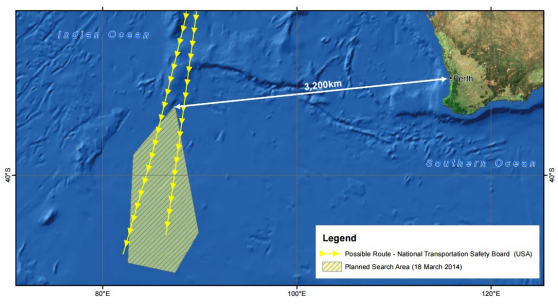
On 5 April 2014, the Chinese patrol ship Haixun 01 picked up a signal of the frequency 37.5kHz, that of underwater locator beacons. It was impossible to verify whether it belonged to MH370. Thirty days after the disappearance of the airplane, the batteries of MH370’s black box were due to run out, and the plane had not yet been found. A sub-surface vehicle with side-scanning sonar was finally deployed in the search. On 28 May 2014, the search was put to a frustrating halt as relevant agencies scrambled to put together a better picture of the seabed.
On 26 June 2014, the search was once again shifted southwards to a new area, in an effort that investigators warned could take up to a year. On 29 January 2015, the Malaysian government finally declared MH370 an accident, allowing the relatives of all 239 passengers and crew presumed dead to begin claiming compensation.
On 29 July 2015, residents of the French island Reunion found debris on the island’s coast. In August, it was confirmed that the debris, a Boeing 777 flaperon, came from the doomed flight. A suitcase was also found, that has yet to yield further clues.
As of July 2016, the multi-national, multi-million dollar effort to find the missing airplane had covered about 290,000 square kilometres, with less than 10,000 square kilometres left in the search area. Once that area is covered, investigators say, the search will be suspended and “rethought”. Further pieces of debris discovered in Mauritius, South Africa and Mozambique, which were “almost certainly” from Flight 370, have not shed further light on the mystery of the missing plane.
The Inherent Need for Multi-Agency, Multi-National Cooperation in SAR Operations
The tragedy of MH370 is instructive for SAR operations in several areas.
Firstly, it highlighted the need for timely, accurate information disseminated clearly and quickly to all search agencies. Although the European Union declared, in the aftermath of the disappearance, that as of 2018, new regulations would require airlines to ensure that their black boxes could now operate for 90 instead of the original 30 days, it is unlikely that the increased lifespan of black boxes will substantially increase the success of SAR operations. Initial search efforts by the Kuala Lumpur Aeronautical Rescue Coordination Centre (ARCC) were activated merely four hours after the air traffic controllers lost contact with the aircraft. The normal cruising speed of a Boeing 777 is 905 kilometres per hour, and in four hours the plane could have travelled 3620 kilometres in any direction. Every minute lost added another 15-kilometre radius to the search. After a plane is downed in the ocean, it is left at the mercy of capricious ocean currents and waves. The unpredictability of ocean drift patterns can be seen in the fact that debris, confirmed to be from Flight 370, washed up on the shores of Reunion, some 5,800 kilometres away from Malaysia. The critical period for SAR operations is therefore in the very minutes after contact is lost with a plane. Four hours was, simply put, not fast enough. The MH370 incident underscores the acute need for the streamlining of interagency cooperation to ensure both the timeliness and accuracy of information provided to first responders.
In view of the need for speed in SAR efforts, one could almost sympathise with China’s fury when the Malaysia government confirmed a full week later that military radars should have pointed the initial search westwards instead of toward the Gulf of Thailand. China’s state news agency Xinhua raged that “Given today’s technology, the delay [smacked] of either dereliction of duty or reluctance to share information in a full and timely manner.” The first inkling of the possibility that MH370 might not have gone down in the Gulf of Thailand was publicly raised only on March 9, when the Chief General of the Royal Malaysian Air Force (RMAF) revealed that his military radar data was being analysed for clues of the missing airplane. This, and the fact that initial search efforts were quickly directed toward the Gulf of Thailand, suggest that inter-agency information-sharing even within Malaysia might have met with obstacles. The multi-national search could therefore have suffered a double disadvantage: That of delayed activation, and also of misinformation.
Secondly, MH370 makes it abundantly clear that any SAR effort, especially involving lost aircraft, absolutely has to be multi-national to even approach the remote possibility of success. The distance covered by the debris of the downed airplane is impossible to cover by any one country’s resources alone. Indeed, as highlighted before, within four to five days of the missing aircraft alert, fourteen countries’ assets were participating in the search. Significantly, the search engendered a moment of mutual cooperation between historically antagonistic neighbours: Vietnam allowed Chinese naval vessels to enter her territorial waters barely a day after the disappearance of the plane.
It should be pointed out that SAR operations must be multi-national not merely because of the large search area involved, but also to ensure sustainability. Malaysian authorities received the support of Australia’s well-established maritime safety infrastructure, and also of the Australian government, which has poured in close to $90 million dollars for continued search efforts. This more than doubled the amount of money set aside for the search, with the Malaysian government pledging to match the $60 million dollars Australia had dedicated specifically to the underwater search effort. China has also pumped in an additional $20 million dollars. At the time of writing, it is highly likely that the search will be suspended soon, if not already suspended, but it is noteworthy that the Malaysian Transport Minister, Liow Tiong Lai, drew attention to the fact that “cost was not a factor in the decision to suspend the hunt”. In addition, Australian Transport Minister Darren Chester emphasised that “every effort [had] been made” in the hunt; “We have used the most high tech and the best people for this search.” It is improbable that the search could have endured for so long, employing technology such as the Autonomous Underwater Vehicle (AUV) Bluefin-21, without harnessing the resources of other countries.
Thirdly, the vanguard of the search was not simply a multi-national force, it was a multi-national military force. While Malaysia immediately fielded assets from the ARCC, RMAF, Royal Malaysian Navy (RMN), and Malaysian Maritime Enforcement Agency (MMEA), the primary responders from other countries were all naval forces. China’s contributions were four warships, of which the Jinggangshan is noteworthy, being equipped with two helicopters, a full medical team of 30 persons, 10 divers and 52 marines. The Philippines responded with one frigate and two corvettes, along with maritime aircraft. Indonesia contributed, amongst others, two fast patrol craft and one corvette. Singapore dispatched a total of three Lockheed C-130s, a corvette, and a Formidable-class stealth frigate, equipped with advanced sonar capabilities. Vietnam added its military aircraft and surveillance craft to the search, while the Royal Australian Air Force responded with their own maritime patrol aircraft. The US despatched two destroyers, a maritime surveillance aircraft and an underway replenishment vessel. By the second week, additional assets from various others countries had arrived on-scene – from Bangladesh, Cambodia, India and Taiwan. It appears that the organisations most well-equipped to be the first responders in this SAR operation were primarily military forces, with emphasis on the naval and air services. For future SAR operations to be successful, greater cooperation between regional naval forces will have to be engendered.
Fourthly, and most importantly, the disappearance of MH370 underscores the lack of regional cooperation in the ASEAN region. The Asian-Pacific navies that contributed to the initial search effort must be commended for their quick and unreserved response to the disaster. It was noted that “the response from the ASEAN maritime states was almost immediate”; the air and naval assets of Brunei, Indonesia, the Philippines, Singapore, Thailand and Vietnam arrived the fastest, and were quickly joined by other regional naval forces. Given that all the ASEAN nations are littoral states, it is no surprise that cooperation on SAR matters has often appeared on ASEAN’s agenda. In the 1992 ASEAN Declaration on the South China Sea, member states resolved to “explore the possibility of cooperation in the South China Sea relating to”, amongst other things, “coordination of search and rescue operations”. The speed of the ASEAN response may paint a rosy picture of how ASEAN states have slowly built a mutual sense of community that spurred them to render aid in all possible ways when one member was experiencing distress. However, a closer look at the 1992 Declaration yields many caveats to cooperation in SAR matters: Such cooperation must be done “without prejudicing the sovereignty and jurisdiction of countries having direct interests in the area”. In the 2002 Declaration on the Conduct of Parties in the South China Sea, SAR operations were relegated to “cooperative activities”, pending “a comprehensive and durable settlement of the (territorial) disputes” that were plaguing the region at that time. The weakness of information-sharing infrastructure in the region was exposed during the search for the missing plane, with poor communication observed between some of the initial search teams, and confusion generated over the contradictory statements made by Malaysia, China and Vietnam – as detailed in the introduction.
Singapore Member of Parliament Lim Wee Kiak, then head of Singapore’s government parliamentary committee for defence and foreign affairs, called the disappearance of the plane a “disturbing sign” that ASEAN countries had allowed sovereign interests to hamper cooperation. He stated that “What [he] found most appalling was this: the plane was in the heart of ASEAN, flying towards Vietnam in the South China Sea. Thailand, Cambodia and the Philippines all nearby. How could everybody miss the plane?” The lack of information-sharing between different air controllers continued well into the search. East Asia Forum noted that ten days elapsed before the Royal Thai Air Force revealed that it had tracked MH370 deviating from its course in a westward direction. The Guardian reported that the Thai military said it had not released the data earlier “because it was not specifically asked”.
Furthermore, it is telling that, although the primary focus of the search for MH370 was re-centred within a few months on the Indian Ocean region, that the search effort was driven primarily by three main countries – Malaysia, China and Australia. Significantly, as highlighted previously, the amount of resources that Australia pumped into the search effort was considerable. As reported by the Guardian in June 2014, three months after the disappearance of the plane, Malaysia had at that time spent about $9.3 million in fuel and rations for searchers, while Australia had put aside $90 million for the search – around $25 million for the visual air search, and another $60 million for the underwater search. In addition to footing a large part of the bill and providing the necessary assets to cover the vast search area, the Australian government also established the Joint Agency Coordination Centre (JACC) to act as the central coordination point for the “whole-of-Australian Government” effort in the search. Then-treasurer of the Australian government, Joe Hockey, justified the seemingly unconditional aid that Australia was rendering toward search efforts:
Mr. Hockey would have been referring to the Maritime Search and Rescue Regions (SRR) determined by the International Maritime Organisation at the 1979 SAR Convention. 13 SAR regions were delineated, in each of which the affected countries would have areas of responsibility to carry out SAR operations in the event of a safety incident out at sea (see Fig. 2).

It seems that, after the initial burst of support from the region, countries have been content to accept Mr. Hockey’s view of maritime responsibility, allowing a few countries – and Australia in particular – to shoulder the cost of the search on the basis of SRR jurisdiction. This is understandable given the politicised nature of cost distribution in any initiative that is not directly related to sovereign interests. However, it cannot be ruled out that the cause of this bystander phenomenon can be traced back to a regional history of prioritising sovereign interests over humanitarian assistance. It is not the intention of this essay to argue the moral validity of doing so; it merely points out that such a mindset is likely to pose obstacles to a deepened cooperation between regional littoral states for maritime SAR operations.
To briefly summarise the second part of this essay, SAR operations must receive timely and accurate information in a clear manner to facilitate the initial search. Also, in view of the staggering costs involved, material support in both cash and technology are needed to continue the search. Therefore, SAR operations usually are best dealt with by regional military – primarily naval and air forces, who have the resources to synthesise the information and react quickly and effectively. All three of these points make it clear that SAR operations are best not rendered a national venture. At the same time, MH370 presents that very situation where multi-agency, multi-national cooperation was necessary to achieve success.
The challenges to a coordinated multi-national approach to SAR operations in the Indian Ocean region
A weak SAR cooperative infrastructure in the Indian Ocean region
The MH370 tragedy made apparent the inevitability Indian Ocean littorals would be involved in dealing with the aftermath of maritime disasters. Apart from Reunion Island, debris confirmed to be from MH370 was also found near Tanzania, on the island of Pemba, and a further two burnt fragments were found on Madagascar. The disappearance of the plane caused much soul-searching to take place among Indian Ocean rim states about the apparent lack of SAR cooperation in the region. Vice Admiral Tim Barrett, Chief of the Royal Australian Navy, in an address to the Indian Ocean Naval Symposium (IONS) in earlier this year, opined that “[the Indian Ocean] is an oceanic region where maritime response requires strategic vision and, in the case of Search and Rescue, a common endeavour.” He further lamented that “the tyranny of maritime distance was exactly what the search for MH370 caught-up for us.” It is worth pausing to examine the current state of regional SAR cooperative infrastructure, and the agencies driving this cooperation.
The Indian Ocean Rim Association (IORA) is currently the only regional forum that has undertaken to address the concerns of some 2 billion people living around the Indian Ocean rim. The IORA website acknowledges that “the countries of the Indian Ocean region are remarkably diverse in terms of size, economic strength, languages and cultures.” IORA expects that “a common commitment to the prosperity and sustainable development of the region” will be the “powerful unifying force” that would drive cross-regional cooperation. Its progress on facilitating multi-national SAR coordination remains weak, however. IORA member states have adopted the existing international conventions on SAR, including the 1974 Convention for the Safety of Life at Sea (SOLAS), 1979 International Convention on Maritime Search and Rescue, 1982 UN Convention of the Law of the Sea, and the International Aeronautical and Maritime Search and Rescue (IAMSAR) Manual. However, perhaps in recognition of the many political obstacles to deeper cooperation, the 1979 SAR Convention limits its call for international SAR coordination to the division of the world’s oceans to the thirteen SRR described above.
SAR initiatives organic to the region have also been infrequent and tentative at best. The 2014 Perth meeting of the 20 IORA member states saw 5 countries – Australia, Comoros, Seychelles, Singapore and South Africa signing a Memorandum of Understanding on SAR cooperation, affirming a commitment to strengthening the region’s disaster-response capabilities. Australia, then-Chair of IORA, also pledged some $2.6 million, to be given over three years and headed by AMSA, to build SAR capabilities in the region, partnering specifically with Mauritius, Sri Lanka and the Maldives. The response from the majority of IORA member states, however, can be summed up in the paragraph dedicated to SAR in the 2014 Perth Communiqué:
The other regional agency involved in tackling pan-regional maritime issues is the Indian Ocean Naval Symposium. As recounted by Vice Admiral (Ret) Pradeep Chauhan, Commandant of the Indian Naval Academy at Ezhimala, the 2008 conception of IONS was a “stupendous effort” by the Indian Navy “to assemble in New Delhi the Chiefs-of-Navy of very nearly all littoral states of the Indian Ocean Region”. In March 2015, the membership of (IONS) was finalised: Member states were confirmed and listed, in alphabetical order, as Australia, Bangladesh, France, India, Indonesia, Iran, Maldives, Mauritius, Mozambique, Myanmar, Oman, Pakistan, Saudi Arabia, Seychelles, Singapore, South Africa, Sri Lanka, Tanzania, Thailand, Timor-Leste, United Arab Emirates and the United Kingdom. An additional four more states signed up for observer status: China, Japan, Madagascar and Malaysia. This represented a remarkable achievement for the Indian Navy in pan-regional engagement. It is Vice Admiral Chauhan’s complaint, however, that the movement has since drifted, with much of the initial momentum dissipated. Activities of IONS, as stipulated by its Business Charter (updated in January 2016), are limited to workshops and seminars; “specialised maritime cooperation” ranging from hydrographic surveys to SAR operations “may be discussed at IONS”.
Some measure of success in building cooperative infrastructure in the Asia Pacific
It is perhaps useful to draw some comparisons between the current work of IORA and IONS to that of the Western Pacific Naval Symposium (WPNS), given that the membership of the three forums contains some overlap – Australia, France, Indonesia, Singapore and Thailand are active participants in all three. In addition, although the MH370 incident makes it abundantly clear that there is much to be desired in regional SAR cooperation, it is worth noting that the first responders at the first search area were all navies from the Asia Pacific. As Vice Admiral Tim Barrett noted, “The breadth and depth of the tragedy of Flight MH370 was matched only by the swiftness and scale of the response.” He lauded the nations who participated in the search as “[demonstrating] some of the classic features of maritime power”; “the readiness and adaptability to respond at short notice; strategic mobility and reach to deploy to one of the most distant locations in the oceans of the world; the persistence to be able to stay on task for a prolonged period of time”. Some healthy skepticism should be shed on Vice Admiral Barrett’s expression of admiration for the regional navies’ “ability to cooperate for common purpose”, given the jumbled state of information-sharing in the immediate aftermath of the crisis. Nonetheless, the near-immediate presence of the various naval assets in the Gulf of Thailand when called upon was a cooperative achievement in and of itself. A closer look at the cooperative frameworks operating in the Asia Pacific region is therefore warranted. Foremost amongst these is the WPNS.
The WPNS was inaugurated in 1988 after the Chiefs of navies participating in the International Seapower Symposium in 1987 concurred that a regional forum would serve as a necessary platform to moot suggestions for deeper regional cooperation. Notably, the WPNS has precipitated some concrete measures to build interoperability between the AsianPacific navies, and to lay down groundwork to enhance the safety of ships at sea. These have been accomplished through a host of multi-lateral exercises carried out under the ambit of the Symposium, and also through the formulation a Code for Unplanned Encounters at Sea (CUES). In August 2015, the Republic of Singapore Navy (RSN) and the Indonesian Navy (TNI-AL) co-hosted the 6th Western Pacific Mine Countermeasure Exercise (WP MCMEX), involving some 800 personnel, 13 ships and 16 countries. In the same year, the RSN hosted a series of shore and sea exercises as part of the International Maritime Defence Exhibition and Conference (IMDEX) Asia, the Maritime Information Sharing Exercise (MARISX) and the WPNS Multilateral Sea Exercise (WMSX). During this set of exercises, CUES was put into play for the first time; conceived in 2014 and described as “a handbook for maneuvers when naval ships and aircraft encounter each other unexpectedly”, it highlights the region’s commitment to improving the safety of ships at sea in the increasingly congested and contested waters of the Asia-Pacific.
The various Asia-Pacific forums such as WPNS and IMDEX Asia have arguably achieved some level of success in regional confidence-building and improvement in interoperability. Admittedly, the WPNS has been running for 20 more years than IONS. However, more reasons can be discovered to explain the lackluster progress in building cooperative infrastructure in the Indian Ocean region.
In a 2007 speech at the Opening Ceremony of the second WMSX, Major-General Desmond Kuek, then-Chief of Defence Force of the Singapore Armed Forces (SAF), noted that a few key factors contributed to the robust activity of WPNS, which was evident even then. These factors can be summarised as, firstly, a shared mindset on the importance of the Southeast Asian sea lines of communication (SLOCs); secondly, common professional experiences; thirdly, a strong tradition of defence diplomacy.
In his speech, MG Kuek raised the point that “the Straits of Malacca and Singapore carry over 30% of the world’s trade and half its oil. These straits are the arteries that connect the economies of East Asia with those of Europe and the Middle East.” Evidence that a shared understanding of the importance of these SLOCs exists can be found in the commitment of Indonesia, Malaysia, Singapore and Thailand to forming and maintaining the Malacca Straits Patrol (MSP). These patrols comprise the Malacca Straits Sea Patrol, the “Eyes in the Sky” Combined Maritime Air Patrols, and the Intelligence Exchange Group. In April 2016, the four countries gathered in Singapore to commemorate the 10th Anniversary of the MSP. Concurrently, the 4th MSP Exercise was underway at the RSN’s Information Fusion Centre, where the sharing of real-time information received from the countries’ combined patrol assets “sought to reinforce information-sharing linkages between the MSP members, and enhance mutual understanding and collaboration.” The countries’ investment in such coordination and information-sharing has produced concrete results; in September 2016, the Straits Times reported a “nosedive” in the number of piracy and maritime robbery cases in the first half of the year. Only one case was recorded during this period, compared to 104 cases in 2015. The drop in regional piracy incidents was attributed to the “concerted effort” by Indonesia, Malaysia and Singapore to curb the spike in piracy cases in 2015. Clearly, a shared regional understanding of the importance of preserving the security of Southeast Asian SLOCs has been a key impetus in driving cooperative activity.
It is not clear from MG Kuek’s speech what “common professional experiences” refer to. However, given that the speech was made in 2007, and that MG Kuek’s language made it apparent that such common professional experiences were an ongoing event, it is highly likely that the phrase points towards the common regional experience of military modernisation, which has taken place in the last five decades. Dr Andrew Tan, Assistant Professor at the Institute of Defence and Strategic Studies in Singapore, dates the regional push for force modernisation to 1975, and argues that this push picked up momentum in the 1980s and 1990s. Comparative data of regional military assets taken from The Military Balance supports his argument (see Fig.3 and 4).
| Country | Military Manpower | Tanks | APCs | 155mm Howitzers | Missile Craft | Combat Helicopters | Combat Aircraft |
|---|---|---|---|---|---|---|---|
| S'pore | 52,000 | 75 | ? | 0 | 6 | 0 | 65 |
| Malaysia | 92,000 | 0 | 700 | 0 | 8 | 0 | 36 |
| Indonesia | 270,000 | ? | ? | 0 | …(2) | 0 | …(2) |
| Thailand | 396,000 | 195 | 200 | 12 | 0 | 0 | 105 |
| Philippine | 274,000 | 8 | 20 | 5 | 0 | 0 | 36 |
| Brunei (3) | … | … | … | … | … | … | … |
| N. Vietnam | …(4) | …(4) | …(4) | …(4) | …(4) | …(4) | …(4) |
| Burma | 159,000 | 0 | ? | 0 | 0 | 0 | 11 |
| Laos | 63,000 | 10 | ? | ? | 0 | 0 | 81(5) |
| Cambodia | 220,000 | ? | 175 | 20 | 0 | 16 | 64 |
| Country | Military Manpower | Tanks | APCs(2) | 155mm Howitzers | Missile Craft | Combat Helicopters | Combat Aircraft |
|---|---|---|---|---|---|---|---|
| S'pore | 323,000 | 410 | 1074 | 123 | 24 | 20 | 157 |
| Malaysia | 150,000 | 26 | 1210 | 12 | 14 | 0 | 89 |
| Indonesia | 876,000 | 455 | 696 | 0 | 14 | 0 | 91 |
| Thailand | 506,000 | 787 | 1117 | 218 | 16 | 0 | 206 |
| Philippine | 249,000 | 41 | 569 | 12 | 0 | 99 | 39 |
| Brunei | 6,000 | 16 | 52 | 0 | 3 | 6 | 0 |
| Vietnam | 484,000(3) | 1935 | 1500 | ?(4) | 11 | 43 | 201 |
| Myanmar | 435,000 | 231 | 385 | 0 | 6 | 22 | 121 |
| Laos | 29,000 | 55 | 70 | ? | 0 | 0 | 26 |
| Kampuchea | 139,000 | 110 | 240 | 0 | 0 | 0 | 24 |
Dr Tan’s working paper, written in 2004, details trends that have continued up to today. In 2015, the Straits Times reported three main areas of growth in regional naval forces. Firstly, military budgets ballooned, but defence expenditure as a fraction of GDP stayed relatively constant. After the Asian economic crisis of the late 1990s, buoyant economic trends in the 2000s kept defence spending robust and manageable. While Indonesia’s defence budget quadrupled and Malaysia’s doubled in absolute terms, in percentages of GDP they remained quite constant at 0.9 and 1.5 per cent respectively. High defence spending across the region has also allowed naval capability-building in the region to progress on a relatively even plane, leading to the second area of growth: There has been an expansion in the number of “largish surface combatants” acquired by regional navies, such as Singapore’s Formidableclass frigates and Indonesia’s Bung Tomo-class multi-role corvettes. Thirdly, the acquisition of submarines has received particular emphasis in the region. Malaysia has procured two Scorpène-class submarines, while Vietnam has purchased six Kilo-class submarines from Russia. Singapore has invested in two costly, brand-new Type-218SG boats from Germany, while Indonesia’s second Chang Bogo-class submarine was recently launched by the South Korean shipbuilding company Daewoo. The fact that regional navies have modernised on roughly parallel lines has given the navies in Southeast Asia a greater basis for collaboration, information-sharing, and also expanded the room for interoperability between navies. The expansion in Southeast Asian naval capabilities has also allowed them to engage more powerful navies such as the People’s Liberation Army Navy (PLAN) and the United States Navy (USN).
Indeed, the expansion of regional naval capabilities has also provided more areas for regional navies to engage in defence diplomacy. Besides the multilateral exercises hosted by WPNS, regional navies have strengthened mutual ties through other defence arrangements and exercises such as the Five Power Defence Arrangements, comprising Britain, Australia, New Zealand and Singapore. As a sign that extra-regional powers are taking notice of this region, British Secretary Michael Fallon said that Britain was planning to station one of its not-yet-completed aircraft carriers in the region. Other multi-national forums in the region include the ASEAN Defence Ministers’ Meeting (ADMM-Plus), with China and the US numbered amongst its 18 member states. Notably, many members of the WPNS take part in the biannual Rim of the Pacific (RIMPAC) multinational exercise, hosted by the Commander of the US Pacific Fleet. 16 out of 26 of the participating nations in RIMPAC 2016 also hold membership in WPNS, underscoring the number of linkages between the navies of the Asia Pacific region.
In summary, the navies of the Asia Pacific region responded in a robust manner to the MH370 crisis, although communication and transparent information-sharing between the search members were imperfect. The quick concentration of naval assets in the Gulf of Thailand, however, may be counted as a regional achievement in maritime cooperation. The reason for this achievement may be found in several factors: A shared understanding of the maritime environment in the region, a common experience in military modernisation, and lastly, the thickening web of multilateral links in the region, where cooperation is practised through joint exercises, seminars and regular interactions between regional military personnel. An investigation must now be made into whether similar conditions exist in the Indian Ocean region
Difficulties in Laying the Groundwork for Cooperative Infrastructure in the Indian Ocean Region
Fig. 5 shows the density of shipping in the Indian Ocean. Red sections indicate a high density of shipping, while green indicates a lighter density. As can be seen from the image, the geography of Southeast Asia forces the traffic flow into a narrow channel – the Malacca Strait, making for a more manageable patrol or SAR sector. Resources set aside for SAR operations or counter-piracy patrols need only be directed to this one artery. As previously discussed, the countries bordering this SLOC – Thailand, Indonesia, Malaysia and Singapore – have pooled their assets for greater surveillance in this one area. In contrast, the Indian Ocean is host to two or three main SLOCs; the image shows dense shipping routes connecting the south tip of South Africa to the northern tip of Sumatra, emerging from round the Somalian horn, and many other routes of lighter density traversing the whole of the Indian Ocean. It does not require sophisticated arguments to see that it will be difficult to form a consensus about where to focus surveillance and patrol resources.

In addition, the common experience of rapid force modernisation does not apply in the Indian Ocean region. Some countries around the Indian Ocean rim do not possess a navy in the strict sense of the term. Mauritius and the Maldives, for example, possess coast guards. Mauritius’ most advanced ship is the MCGS Barracuda, the first export by an Indian shipyard. The Maldives, with some 2,000 atolls and islands to patrol, has chosen to invest in a fleet of around 20 patrol craft and small boats, rather than in any blue water capabilities. Given the large disparity in professional experiences and capabilities, it is difficult to see how the Indian Ocean navies may follow in the footsteps of their Asian Pacific counterparts.
The Way Forward
Nonetheless, if the deficit in regional cooperation exhibited during the MH370 crisis is to be addressed, regional navies can choose to concentrate their resources in a few key areas. As highlighted in the analysis of lessons learnt from MH370, only a multi-national effort undertaken by highly capable organisations – namely, navies and maritime military assets – with clear, timely and accurate information can have a shadow of a hope in preventing or mitigating a maritime disaster. To achieve this, resources – both material and diplomatic – must be injected firstly into increasing the surveillance and response capabilities of the region, and secondly into increasing mutual confidence and willingness for transparent informationsharing between nations.
Australia and India have already taken up leadership roles in levelling up regional surveillance and disaster response capabilities. Much has already been said about Australia’s sense of responsibility toward the region, including its considerable monetary pledge to increase the SAR capabilities of Mauritius, Maldives and Sri Lanka. India’s leadership in the region deserves further attention. As noted, IONS was an Indian initiative and India continues to attempt to engage the region in tangible and practical ways. In March 2015, Prime Minister Narendra Modi visited Mauritius and Seychelles, signalling a renewed focus on strengthening regional partnerships. During the trip, Modi gifted Seychelles with a second Dornier aircraft for maritime surveillance, concluded an agreement for the conduct of hydrographic surveys, and announced the beginning of a “coastal surveillance radar project”. As reported by the National Interest, this project aims to establish a network of surveillance radars in India, Mauritius, Seychelles, Sri Lanka and Maldives, over 80 radar nodes linked to a central analysis centre near Delhi. In his visit to Mauritius, Modi witnessed the commissioning of the aforementioned MCGS Barracuda, and also made agreements to develop transport and communication infrastructure in the Assumption Island of Seychelles and Aga Lega of Mauritius. Improving regional capabilities do not require much politicking between many nations; the efficacy of bilateral or trilateral agreements between large and small navies makes this goal a low-hanging fruit. This is therefore one area that should be tackled directly by countries with the capacity to do so
Indian efforts to create an advanced, centralised hub for information-sharing mirror Singapore’s Information Fusion Centre (IFC). The IFC, inaugurated in April 2009, has ties with 65 agencies in 35 countries, and permanently houses 16 International Liaison Officers (ILOs) from 15 countries. Facilitating real-time information-sharing and analysis, the IFC has been crucial in allowing regional navies to respond quickly and effectively to maritime hijacking incidents and other forms of piracy. In April 2014, Singapore’s Ministry of Defence also offered the services of the IFC in coordinating the search for MH370; the offer “received support” at the informal ASEAN-US Defence Minister’s meeting. The IFC provides one model for Indian Ocean littorals to actualise maritime security partnerships. Vice Admiral Tim Barrett, for example, has expressed his desire to see a greater deployment of ILOs across the region; he argued that the presence of ILOs in regional headquarters was “one of the most effective ways to enhance communications”, especially in “the most time sensitive tasks” such as SAR operations. Not only would ILOs be useful in communication between states, but between different national agencies – including civilian agencies. Singapore’s IFC, for example, works closely with home agencies such as Customs and the Maritime Port Authority of Singapore. Vice Admiral Barrett cautioned that ILOs should be of “high quality”, and importantly, “they must be trusted”, and be invested with the “ability to establish trust in the headquarters to which they are deployed.” Indeed, the presence of ILOs is both a symbol of mutual trust and a method to reinforce this trust. Through a network of trusted individuals, the region might come another step closer towards achieving the streamlining of operational and communication processes necessary to firstly, prevent maritime disasters and secondly, mitigate the effects of maritime disasters that will inevitably happen.
Conclusion
While the task of regional capability building can be left to bilateral or trilateral efforts, the task of building interoperability and mutual confidence remains a regional responsibility. It has become apparent through the MH370 incident, the safety of lives at sea is a regional responsibility. IORA and IONS remain potent platforms to realise this goal. New life must be injected into these forums by taking concrete steps to reinforce regional cooperation. It remains to be seen whether these regional organisations can overcome the vast cultural and professional divides within the Indian Ocean region. There is, unfortunately, no easy way to deepen regional cooperation; it will likely be achieved through fits and starts, and many failed initiatives. Nonetheless, governments must come to realise that the safety of their own citizens at sea is not achievable without a collective sense of responsibility and pooling of resources. It can only be hoped that the regional cooperative infrastructure can be strengthened sufficiently before the next maritime disaster strikes.
Bibliography
- Adam, Shamim. “Timeline: The Search for MH370.” Bloomberg, August 6, 2015. Accessed October 19, 2016. http://www.bloomberg.com/news/articles/2015-08-05/timelinethe-17-month-search-for-mh370.
- ASEAN. “1992 ASEAN Declaration on the South China Sea.” Accessed October 20, 2016, http://www.aseansec.org/1196.html.
- Australian Associated Press. “MH370 search: Australia has spent far more than Malaysia.” June 10, 2014. Accessed October 20, 2016.https://www.theguardian.com/world/2014/jun/10/mh370-malaysia-has-spent-only-a-fractionof-what-australia-has.
- Australian Maritime Safety Authority. “Search for Malaysia Airlines flight MH370.” Accessed October 19, 2016. http://www.amsa.gov.au/media/mh370-timeline.
- Australian Navy. “IONS Charter of Business.” January 13, 2016. Accessed October 26, 2016.
- http://www.navy.gov.au/sites/default/files/documents/IONS%20Charter%20Version%202-0%2013%20January%202016.pdf.
- Australian Navy. “IONS Membership Finalised.” Accessed October 26, 2016. http://www.navy.gov.au/ions/ions-membership-finalised.
- Barrett, Tim, Vice Admiral. “Chief of Navy Speeches: Cooperative Maritime Search and Rescue in the Indian Ocean Region – IONS address.” Australian Navy, January 11, 2016. Accessed October 26, 2016. http://www.navy.gov.au/media-room/publications/chief-navyspeeches-cooperative-maritime-search-and-rescue-indian-ocean.
- BBC News. “MH370 search: New debris in Madagascar includes ‘burnt parts’.” 12 September 2016. Accessed October 20, 2016. http://www.bbc.com/news/world-asia37333762.
- Bergin, Anthony. “The Indian Ocean Rim Association: a progress report.” The Strategist, October 16, 2014. Accessed October 26, 2016. . http://www.aspistrategist.org.au/the-indian-ocean-rim-association-a-progress-report.
- Chan, KL and Park, Madison. “MH370 search to be suspended if plane isn’t found soon.” Channel News Asia, July 24, 2016. Accessed October 19, 2016. http://edition.cnn.com/2016/07/22/asia/mh370-search-suspended.
- Chauhan, Pradeep, Vice Admiral. “IONS Maritime Security.” May 26, 2016. Accessed October 26, 2016. http://www.marsecreview.com/2016/05/ions-maritime-security.
- China Military Online. “Chinese warship participates in IMDEX Asia 2015.” May 20, 2015. Accessed October 27, 2016. http://english.chinamil.com.cn/news-channels/chinamilitary-news/2015-05/20/content_6498653.html.
- Chow, Jermyn. “Five Power Defence Arrangements ‘more necessary than ever’ for regional stability: UK defence chief Fallon.” The Straits Times, June 4, 2016. Accessed October 27, 2016.http://www.straitstimes.com/asia/se-asia/five-power-defencearrangements-more-necessary-than-ever-for-regional-stability-uk.
- Farrell, Paul; Weaver, Matthew and McCarthy, Tom. “MH370: Ban on overflights and delays in sharing data hamper search.” The Guardian, March 18, 2014. Accessed October 20, 2016. https://www.theguardian.com/world/2014/mar/18/mh370-missing-plane-search-live.
- Hogan, Jacob. “ASEAN’s haphazard response to MH370 disaster.” East Asia Forum, April 8, 2014. Accessed October 20, 2016. http://www.eastasiaforum.org/2014/04/08/aseanshaphazard-response-to-mh370-disaster.
- Joint Agency Coordination Centre. “About Us.” Accessed October 20, 2016. http://jacc.gov.au/about.aspx.
- Koh, Eng Beng. “Strengthening cooperation in maritime security & submarine operational safety.” Singapore MINDEF, May 20, 2015. Accessed October 27, 2016, https://www.mindef.gov.sg/imindef/resourcelibrary/cyberpioneer/topics/articles/news/2015/may/20may15_news.print.noimg.html.
- Koh, Jeremy. “Drop in piracy in regional waters.” The Straits Times, September 20, 2016. Accessed October 27, 2016. http://www.straitstimes.com/singapore/drop-in-piracy-inregional-waters.
- Indian Ocean Rim Association. “Final Communiqué.” October 9, 2014. Accessed October 26, 2016. http://www.iora.net/media/151273/communiqu__final.pdf.
- Indian Ocean Rim Association. “IORA Meetings.” Accessed October 26, 2016. http://www.iora.net/iora-meetings.aspx.
- Indian Ocean Rim Association. “Maritime Safety and Security,” Accessed October 26, 2016. http://www.iora.net/about-us/priority-areas/maritime-safety-security.aspx.
- International Maritime Organization. “International Convention on Maritime Search and Rescue (SAR).” Accessed October 20, 2016. imo.org.
- Marine Traffic. “Density Maps.” Accessed October 27, 2016. marinetraffic.com.
- Mohan, C. Raja. "Revealed: India's Master Plan for the Indian Ocean." The National Interest, June 26, 2015. Accessed October 27, 2016. nationalinterest.org.
- Naval Today. “DSME launches second Chang Bogo-class submarine for Indonesia.” October 25, 2016. Accessed October 27, 2016. navaltoday.com.
- Panda, Ankit. “Malaysia Airlines Flight 370 Search and Rescue: Cooperation in the South China Sea.” March 11, 2014. Accessed October 20, 2016. http://jacc.gov.au/about.aspx.
- Reuters. “Malaysia confirms debris found near Tanzania is from missing MH370 jet.” The Guardian, September 15, 2016. Accessed October 20, 2016. theguardian.com.
- Sakhuja, Vijay. “Indian Ocean and the IORA: Search and Rescue Operations.” Institute of Peace and Conflict Studies, November 3, 2014. Accessed October 26, 2016. ipcs.org.
- Singapore Government. “Fact Sheet: Information Fusion Centre (IFC).” April 4, 2014. Accessed October 28, 2016 mindef.gov.sg.
- Singapore Government. “Factsheet: Background of the Western Pacific Naval Symposium and Western Pacific Mine Countermeasure Exercise.” Accessed October 26, 2016. mindef.gov.sg.
- Singapore Government. “Malacca Straits Patrol: Member States Commemorate 10 Years of Cooperation.” April 21, 2016. Accessed October 27, 2016. mindef.gov.sg.
- Tan, Andrew. "Force Modernisation Trends in Southeast Asia." Institute of Defence and Strategic Studies Singapore, January 2004. Accessed October 27, 2016. rsis.edu.sg.
- Tan, Andrew. “Force Modernisation Trends in Southeast Asia.” Institute of Defence and Strategic Studies Singapore, January 2004. Accessed October 27, 2016. thediplomat.com.
- Thayer, Carl. “Flight MH370 Shows Limits of ASEAN’s Maritime Cooperation.” The Diplomat, March 18, 2014. Accessed October 19, 2016. themalaymailonline.com.
- The Malay Mail Online. “MH370 crisis shows lack of cooperation in Asean, says Singapore MP.” Accessed October 20, 2016. themalaymailonline.com.
- The Straits Times. “South-east Asia naval expansion and its risks.” May 14, 2015. Accessed October 27, 2016. straitstimes.com.
- Tiezzi, Shannon. “Small But Positive Signs at Western Pacific Naval Symposium.” The Diplomat, April 24, 2014. Accessed October 27, 2016. thediplomat.com.
- Today Online. “Singapore offers Changi facility as ASEAN disaster response centre.” April 5, 2014. Accessed October 28, 2016. todayonline.com.
- Voa News. “Multinational Search and Rescue (SAR) for Malaysia Airlines Flight MH370.” Accessed October 20, 2016. voanews.com.
- Wikipedia. “MCGS Barracuda.” Accessed October 27, 2016. https://en.wikipedia.org/wiki/MCGS_Barracuda.
- Wikipedia. “Search for Malaysia Airlines Flight 370.” Accessed October 19, 2016. en.wikipedia.org.
- Young, John. “Regional Cooperation in Search and Rescue (SAR) Operations.” Indian Ocean Rim Association. Accessed October 20, 2016. http://www.iora.net/media/158588/8._john_young_presentation.pdf.