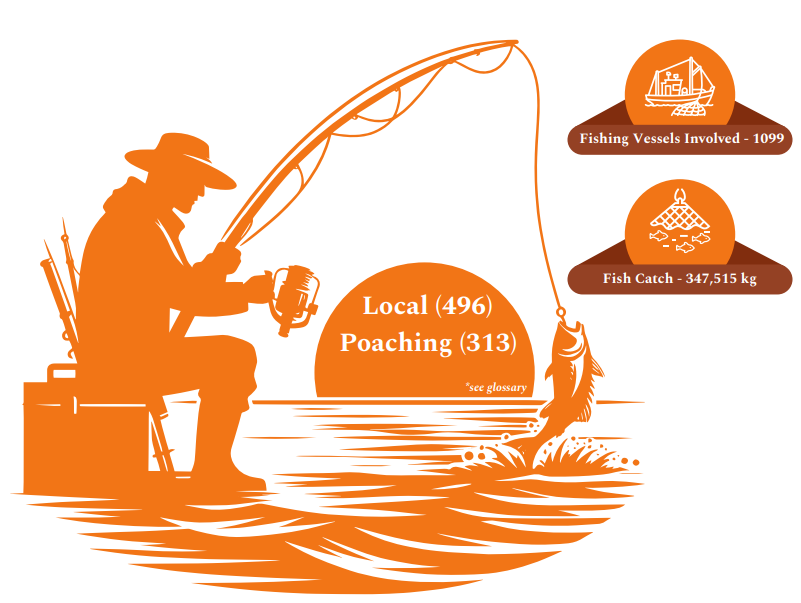
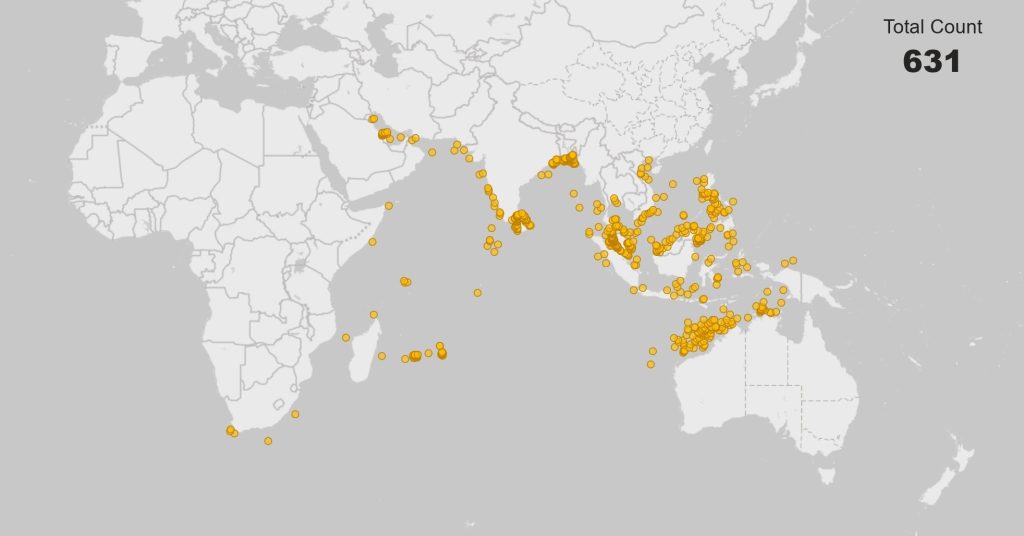
IUU fishing includes illegal activities on the high seas and within national waters. The Centre recorded 809 incidents of IUU Fishing in 2024, similar to 800 in 2023.
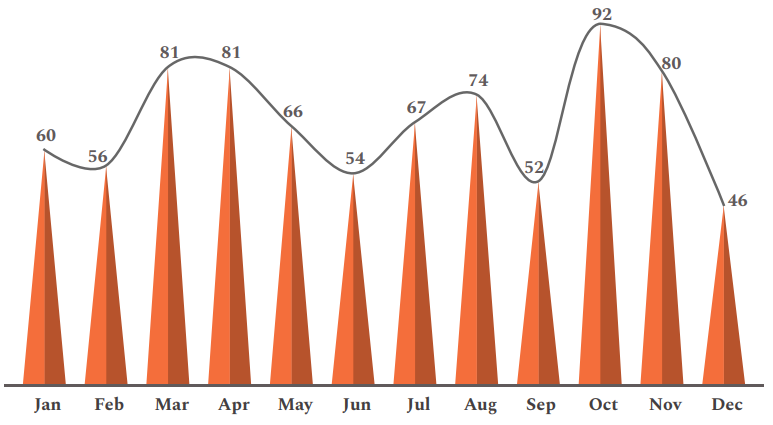
The incident saveraged 67 per month (consistent with 67 in 2023). The incidents peaked to 81 in Mar 2024 and Apr 2024, with a significant drop to 39 in Dec 2024. Seasonal weather patterns, influenced the temporal distribution of fishing activities across different months.
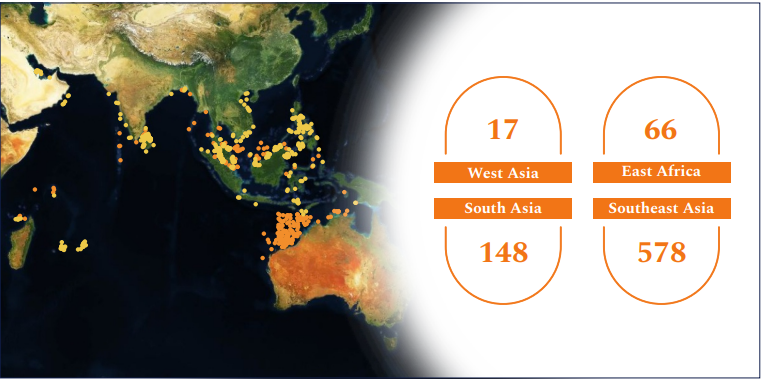
The Centre subdivides these incidents into four distinct regions for the analysis: West Asia (17), East Africa (66), South Asia (148) and Southeast Asia (578).
Key Insight: 673 IUU fishing incidents monitored in 2025, marking a 17% decline from 2024
Illegal, Unreported and Unregulated (IUU) fishing activities pose a profound threat to global food systems, economic stability, maritime security and the overall health of our oceans. In 2025, the Centre monitored 673 reported IUU fishing incidents, witnessing a decrease of 17% from 809 incidents in 2024. As it is challenging to categorise incidents distinctly as 'illegal', 'unreported' or 'unregulated' fishing, the reported incidents have been categorised as 'Local IUU' and 'Poaching' to avoid inaccurate representation of data. These incidents are recorded and analysed across West Asia, East Africa, South Asia and Southeast Asia.

Key Insight: Both local IUU and poaching incidents declined significantly in 2025
Local IUU involves violations by a state's own vessels within its jurisdiction, while poaching refers to foreign vessels acting in violation of another state's laws in an area under that state's jurisdiction. Local IUU fishing and poaching accounted for 63% (424 incidents) and 37% (249 incidents) of reported IUU incidents respectively. Both categories witnessed a decrease compared to 2024, this reflects a 15% reduction in local (496) IUU incidents and a 20% decrease in poaching (313) incidents compared to 2024.
Key Insight: Southeast Asia and South Asia remained primary IUU fishing hotspots despite enhanced enforcement
Southeast Asia continued to account for the highest number of reported incidents, followed by South Asia, reflecting a combination of intensive fishing activity and strengthened enforcement and detection capabilities. Reported incidents throughout the year were strongly influenced by seasonal monsoon patterns, with noticeable declines during peak weather periods. While Local IUU fishing remained the predominant form of infringement, poaching by foreign-flagged vessels and unregulated fishing in Areas Beyond National Jurisdiction (ABNJ) persisted, often exploiting regulatory, jurisdictional and monitoring gaps.
Key Insight: Targeting of high-value species remained a key driver of IUU fishing activity
The sustained targeting of high-value species including tuna, crustaceans, sharks and sea cucumbers, continues to highlight the strong commercial incentives underpinning IUU fishing activity. Overall, trends observed in 2025 indicate a positive impact of enhanced patrols, improved surveillance and more robust enforcement, while simultaneously underscoring the need for further strengthening of legal frameworks, regional co-operation mechanisms, advanced monitoring technologies and community-based interventions to achieve lasting reductions in IUU fishing across the region.
The Indian Ocean Naval Symposium (IONS) is a voluntary initiative that brings together the navies of the Indian Ocean littoral states. Through dialogue, co-operation, and shared understanding, IONS fosters regional maritime security and stability across one of the world’s most strategic oceanic regions.
© Indian Ocean Naval Symposium (IONS) 2026 – All Rights Reserved