
Contraband smuggling involves the illegal movement and distribution of prohibited goods, bypassing established legal and regulatory systems via both land and maritime routes. Regional law enforcement agencies have reported a surge in contraband smuggling via sea routes, often disguised as legitimate cargo. The Indian Ocean Region (IOR) remains a hotspot for narcotics trafficking and related maritime offences, particularly in the notorious Golden Triangle and Golden Crescent areas.
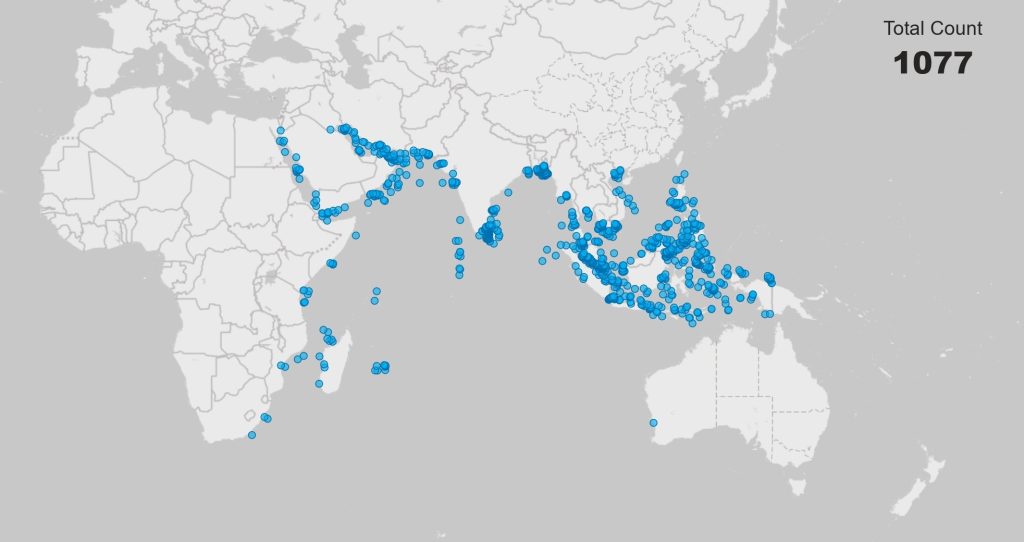
The instances have been geographically grouped under four distinct regions, namely West Asia (80), East Africa (46), South Asia (300), and Southeast Asia (651), to delve into region-specific dynamics and trends.
The instances have been geographically grouped under four distinct regions, namely West Asia (80), East Africa (46), South Asia (300), and Southeast Asia (651), to delve into region-specific dynamics and trends.
Key Insight: 1077- 1197 incidents recorded in 2025, marginally higher than 1,047 in 2024
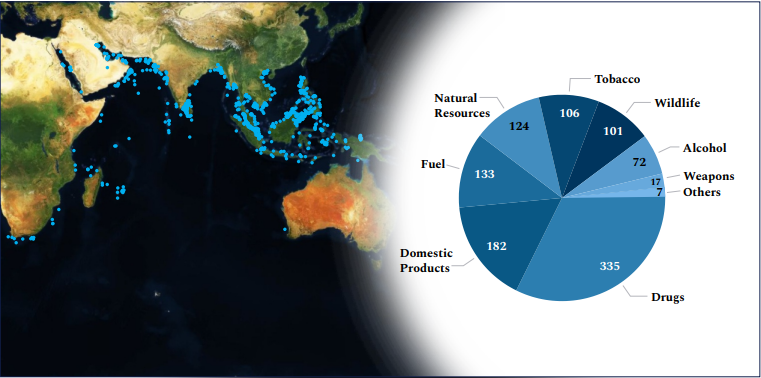
In 2025, 1,077 - 1197 incidents of Contraband Smuggling were recorded across the IOR, slightly higher than the 1,047 incidents monitored in 2024 with an average of 90 monthly seizures. These incidents are categorised into Drugs, Domestic Products, Natural Resources, Fuel, Tobacco, Alcohol, Weapons and Wildlife analysed across West Asia, East Africa, South Asia and Southeast Asia.
Key Insight: Shift toward synthetic drug production and sophisticated trafficking routes observed in 2025
Drug smuggling remained the largest contributor to maritime contraband activity in 2025, accounting for 325- 346 incidents (about 30%), concentrated along routes linked to the Golden Crescent and Golden Triangle. Seizures of hashish, heroin and cannabis increased sharply, with opiate seizures rising more than tenfold from 478 kg in 2024 to 5,728 kg in 2025. Amphetamine Type Substances (ATS) trafficking remained broadly stable in incident count (179- 196 seizures), but West Asia recorded a major escalation in quantities of ATS seized, increasing from 23,982 kg to 65,070 kg, indicating a shift toward synthetic drug production in this region. Cocaine seizures declined in number (15 incidents) but doubled in volume to over 3,052 kg, reflecting persistent demand and increasingly sophisticated trafficking methods. Within this broader trend, Bangladesh witnessed the emergence of a barter-based smuggling model, involving the exchange of domestic and commercial goods for narcotics sourced from the Golden Triangle, highlighting an evolving convergence between licit trade commodities and organised drug trafficking networks across South and Southeast Asian maritime routes.
Key Insight: Short-range cross-border maritime routes enabled sustained smuggling of domestic goods and fuel
Domestic products smuggling emerged as the second largest category in 2025, accounting for 248 incidents (about 21%), with Southeast Asia recording the highest number of seizures, followed by South Asia, where repeated attempts to smuggle foodstuffs, construction materials and consumer goods by sea were observed. Organised fuel smuggling in West Asia and South Asia from Iran through Persian Gulf and Arabian Sea routes has been observed as a significant emerging trend, driven by price differentials and sanctions, despite active enforcement by Iran. In comparison, fuel smuggling in Southeast Asia was more widespread but smaller in scale with Vietnam, Malaysia and Indonesia reporting the highest number of incidents. Incidents in Southeast Asia reflect cross-border diversions linked to regional price and subsidy differentials along short-range maritime routes.
The Indian Ocean Naval Symposium (IONS) is a voluntary initiative that brings together the navies of the Indian Ocean littoral states. Through dialogue, co-operation, and shared understanding, IONS fosters regional maritime security and stability across one of the world’s most strategic oceanic regions.
© Indian Ocean Naval Symposium (IONS) 2026 – All Rights Reserved